
Mentor Training #5

Part 2 - Anticipatory Sets

Only editable by group admins

  • Last updated June 17, 2024 at 6:24 AM
  • Evidence visible to public
You will read about anticipatory sets and how it engages students in a lesson. You will consider your own teaching practice as well as those of your colleagues to consider how to best support a new teacher.

In This Task...

You will read about anticipatory sets and how it engages students in a lesson. You will consider your own teaching practice as well as those of your colleagues to consider how to best support a new teacher.

Your Task...

  1. Read the article “Boost Classroom Engagement with Anticipatory Sets”
    1. https://drive.google.com/file/d/1CUARLzAQYFZxQb3TqlJKtyeoTIW3__Ug/view?usp=sharing
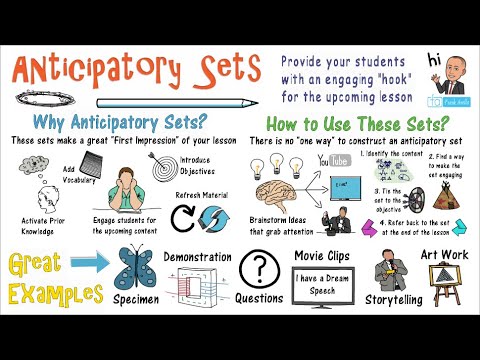
  2. Watch the video Anticipatory Sets (00:00-3:27)
    • “Anticipatory sets are often one of the most neglected yet most powerful tools in a teachers arsenal.”
      • 0:36 Activate Prior Knowledge
      • 1:22 Brainstorm Ideas that Grab Attention
      • 2:22 Examples Specimen

Evidence of Learning...

  1. Using what you have learned (and already know) about anticipatory sets, share (in 1-2 paragraphs) a very memorable lesson with a killer “hook” or anticipatory set. 
    1. Consider the following prompts:
    • Provide detail about the subject area, learning targets etc.
    • What made it so effective?
    • What (if anything) would you change if you taught the same lesson again?

All posted evidence

Anticipatory sets

Anticipatory Sets
Great refresher on the importance of anticipatory sets.  The article was good because it gave different reasons to use an anticipatory set, whether you are introducing new material/content/skills or you are review/reteaching.  It was also good to watch the video as he spoke about good examples so the video would be really good for a new teacher to watch.  I am sure they have done anticipatory sets as an assignment in an Ed course while in college, but I do think that many of the assignments that are done in Ed courses feel so isolated from an actual classroom setting.

A lesson I remember in which I think I had a good anticipatory set was when I put up the picture of the Napalm girl from the Vietnam War in 1972.  In my US history class, we were studying the 60’s and 70’s and we spent a little bit of time learning about the Vietnam War as part of the larger Cold War.  Students were familiar with vocab such as guerilla warfare as well as chemical warfare and total war.  We also had already covered the reasons that the US was involved in the Vietnam War as well as the concept of the domino effect connected to the Cold War.

As students came in the room, the picture was up on the board.  I had a half sheet of paper for them that asked  them to document what they saw in the photo, what they thought was going on in the photo, and 2 questions that they had about the photo.  There was definitely a hush in the room as students studied the photo.  A couple kids giggled a little but I actually expected that as sometimes things that are overwhelming cause an inappropriate emotional response.  Overall, I thought the anticipatory set was good because students really spent some time looking closely at the photo and then thinking about what they saw.  Many had questions about the little girl who was naked and crying, such as whether she died.  Also, there were questions about why the soldiers in the photo appear to be doing nothing to help the children.  After giving some background about the photo and discussing the prompts from their sheets, we talked about the very idea of war and total war and civilians in war.  I distinctly remember a student saying he isn’t sure if there is a valid reason for war when you look at a photo like that and think about the impact of that one incident on those children.  Someone else suggested that perhaps it might have been better for those kids if they had just died so that they didn’t have to live with those memories.  It was a heavy lesson, but the discussion was good and I felt like students had a much greater appreciation of decisions that are made and that there are very few good and bad decisions, but instead of decisions that are made based on the pros and cons of a time and situation.  Perhaps the only thing I might change is giving the students a heads up regarding the nudity in the photo ahead of showing it on the board.
sconnors Over 1 year ago

part 2

A hook that was memorable for an anticipatory set was when I was being coached and we used video clips to come up with lessons that was being portrayed from the video clip. This hook was used so that kids could easily come up with lessons from watching a video clip. We chose a video clip so that we could focus on just the skill without the reading. We then added reading into it by having students read a short story and apply what they practiced in the hook to help come up with a lesson that their short story was teaching. A different approach would be to provide different lessons and have them come up with ways that they have met that lesson in their own life. This would be another effective anticipatory set because students love to make connections and share about their own life. 
lindsay-gimlin Over 1 year ago

Reflection: Anticipatory Sets

A memory hook I used in one of my lessons was during one of the first reading units of the year(Kindergarten reading). The teaching point was for the students to be able to act out parts of a story by thinking about how the character feels and how the character would look, sound and act. When readers act out a story, readers use their face, body and voice to help the characters come to life.I started the lesson by playing charades. The students had to guess what I was doing just by my motions and expressions. Immediately the students were hooked in the game of charades leading them up to the teaching point. This got the students engaged and then I had their attention when it came to the teaching point, teaching them how to bring their books to life. This hook made it so effective because the students were actively participating AND it was an activity they could connect and relate to. I personally would not do anything differently within this lesson. At the end of the lessons students were successfully able to bring their books to life by acting like the characters in their books.
julia-taboni Over 1 year ago

Anticipatory Sets (Mantione)

A very memorable hook I've used on a lesson was one that involved a quote and then a connection with that quote. The quote discussed how you can learn a lot about a person the way they handle various situations. I then quick described how I myself would handle some of the situations. The connection was that when you learn about they way someone handles problems we learn about them as a person. We ultimately learn how we could or should handle difficult situations in the future. It teaches us a life lesson. This lesson is a theme or a central idea that we can use and apply to different situations. Through this connection kids start then think about the way they would handle those difficult situations. They instantly engaged in the connection and I have their focus when sharing the teaching point. This new way of approaching life and literature allows students to use their background knowledge and build upon what they already know about the topic or situation.

Theme is a reoccurring element in literature and it is important that as students grow and become more mature, they begin to think about theme in more complex ways. This connection or hook into the lesson is one of my favorites and is repeatedly discussed throughout the rest of the year.  
kmantione Over 1 year ago

Anticipatory Sets

     When I taught at the High School, I used the NYS Driver Manual for my resource room reading group.  Since most of my kids were in 10th grade, they were excited and motivated to get their driver's permit.  The goal was to read Chapter 5:  Intersections and Turns:  Right-Of-Way, and be able to know how to precede, as a driver, in 3 different situations.  As my Anticipatory Set, I showed 3 videos. 
     Video #1:  I showed a video to 2 cars coming to an intersection and asked, "Who should go first and why?".  Most of the kids said, "Whoever gets there first".  After looking and reading the manual, they learned that the driver on the left must yield the right-of-way to the driver on the right.  This lead to more discussion about the vocabulary in the manual, such as, "yield" and "right-of-way". 
     Video #2:  I then showed a video of a car stoped at a red light.  A pedestrian steps into a crosswalk and the light turns green.  I stopped the video and asked what should the stopped car do?  We then read in the manual that you must yield to pedestrians crosswalk on your left and right before you turn.  Again, we clarified vocabulary such as, "pedestrian" and "crosswalk" to ensure comprehension. 
     Video #3:  Finally, I showed a video of traffic backed up on both sides of an intersection and asked what should the next car do?  Most of the kids said to follow the car in front of them, even if it blocks the intersection.  We read how you can't enter an intersection if traffic is backed up on the other side and you cannot get through the intersection.  You need to wait until traffic ahead clears, so you do not block the intersection.
     This lesson was highly motivating and used real-world examples.
jackie1019 Over 1 year ago

Anticipatory Sets

One anticipatory set I really like using is a video clip I created to begin an ark of teaching Photosynthesis. The video shows disks of spinach leaves cut out with a plastic straw. The discs have been treated to remove all air from them, so they have sunk to the bottom of a beaker filled with what appears in the video to be pure water. As the video plays, it’s nature displays that it is a time-lapse video. The discs rise up to the surface and float. Why would this be? I show the video a few different times. The students create a “Notice-Wonder” T-chart (on my top-five favorite chart types) after a couple of viewings. We continue to share out some notice wonder pieces with the group. Obviously, the initial set leads directly to the lesson, but there are several pieces here that I think make it especially good. 
  1. Students appreciate materials created by their own teacher. They are also very good about materials I find and disseminate, but there is something special when you make the items yourself in a novel fashion. 
  2. There is a hook of a video. I do not overuse videos at all in my lessons, so this is novel and instantly engages the students. 
  3. Student really appreciate being able to watch a video with no task, no job. It relaxes them, and allows their minds to wander and be curious, instead of forcing them into worker-bee mode.
  4. With multiple watches of a 30 second video, they know what to expect, so start to notice other tiny details. This is great science practice, and the things they notice really lead us into some great discussions.
  5. This whole thing becomes the backbone and anchoring phenomena for our photosynthesis learning.
john-elliott Over 1 year ago

Part II Anticipatory Sets

jduma Over 1 year ago

Part 2

Here in italics is an excerpt on a lesson that I modified from the NCTM involving correlation and predicting. https://www.nctm.org/uploadedFiles/Content/Lessons/Resources/6-8/Barbie-AS-Project.pdf

KEN YOU PROTECT BARBIE?
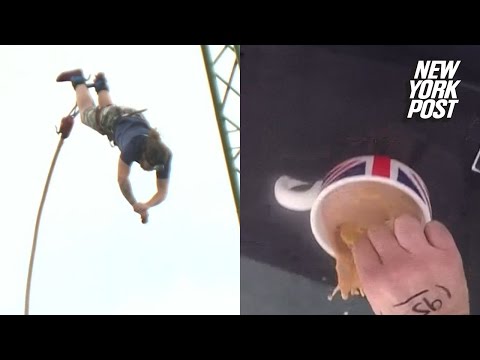
A typical fall from a bungee jump is about 35 to 40 feet. Some extreme jumps can be 100 feet or more. (*)We will model these jumps using dolls and determine the maximum number of rubber bands to create the biggest thrills without injuring the dolls. Here is a video of a 240 foot bungee jump:
STEP 1: Initial Measurements and Ideas
1. Given that a typical Barbie Doll follows a play-scale of 1:6, determine the height of each of the following:
a. The height of an 11 inch Barbie if they were a real sized human.
b. The height of a 35 foot drop in real life, if it were scaled down into play-scale in feet.
c. The height of a 35 foot drop in real life, if it were scaled down into play-scale in inches.
d. The height of a 100 foot drop in real life if it were scaled down into play-scale in inches.

2. Complete the following conjectures on your own, do not ask another person for their answer until you have made your own estimates first.
Hypothesis A: I believe _______ is the maximum number of rubber bands needed to keep the doll safe if it fell proportionate to its height 35 feet.
Hypothesis B: I believe _______ is the maximum number of rubber bands needed to keep the doll safe if it fell proportionate to its height 100 feet.
The activity allows students to understand what bungee jumping is, recall what they know about scale models, think about physics, make predictions, and share their thoughts. This provided a good foundation for a rather successful lesson that I tried just last year. I think I may have mentioned something about the purpose of the activity during the video, but above where you see (*) I may include a sentence such as… Using a scale model we can examine how the jump lengths can be maximized safely.
mizydorczak Over 1 year ago

Anticipatory Sets

In math class, it is crucial that the first task of the lesson is accessible to all students, although it can serve different purposes for the lesson.  Some anticipatory sets activate a pre-requisite skill needed for the lesson.  Others can be used to promote a discussion of mathematical vocabulary by creating the need to define a mathematical pattern being noticed by the students.  Others can be used to introduce the topic in a nontraditional way.

The lesson I am detailing comes from the functions unit of 8th grade math.  The objective of the lesson was to introduce linear vs. nonlinear functions and to define the characteristics of each.  Students have previously studied linear relationships and the definition of a function.  In the anticipatory set for the lesson students are shown two visual patterns, one of which is modeling linear growth and one nonlinear, though they do not yet know this.  The task asks the kids to determine how the pattern is growing and use a method of their choice to determine what a future step in each pattern would look like.  The reason why this set is so effective is that is accessible to all and naturally differentiates based on the student.  Students may visually notice how the patterns are growing and choose to draw the future steps to the patterns.  Others may make data tables and use numerical patterns to find the future step in the pattern.  Although not typically used at first by students, graphs and algebraic expressions can also be used to complete the task.  Because of the various ways to approach the anticipatory set, it is then used as an anchor throughout the lesson to compare the tabular, algebraic and graphic representations of the patterns in addition to the visual.  Once the graphic representations are shown, it is clear that one pattern is representing a linear function while the other is nonlinear.  By then contrasting the other representations of the patterns, the characteristics of linear and nonlinear functions are defined across all representations.  I have used this lesson successfully at the math 8 level, and I have created a version of this lesson that levels up to algebra and contrasts linear, exponential and quadratic growth.  I appreciate how accessible the abstract concepts are made by using visual patterns and student intuition to do the initial exploration of the lesson objective.
denea-czapla Over 1 year ago