
Mentor Training #5

Part 2 - Anticipatory Sets

Only editable by group admins

  • Last updated June 17, 2024 at 6:24 AM
  • Evidence visible to public
You will read about anticipatory sets and how it engages students in a lesson. You will consider your own teaching practice as well as those of your colleagues to consider how to best support a new teacher.

In This Task...

You will read about anticipatory sets and how it engages students in a lesson. You will consider your own teaching practice as well as those of your colleagues to consider how to best support a new teacher.

Your Task...

  1. Read the article “Boost Classroom Engagement with Anticipatory Sets”
    1. https://drive.google.com/file/d/1CUARLzAQYFZxQb3TqlJKtyeoTIW3__Ug/view?usp=sharing
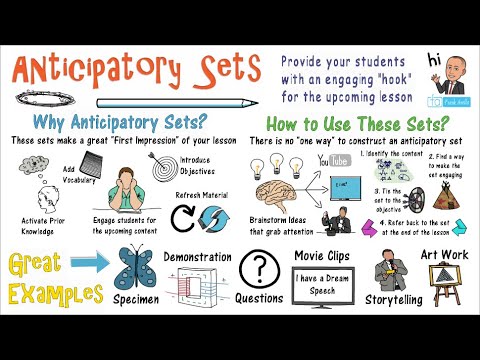
  2. Watch the video Anticipatory Sets (00:00-3:27)
    • “Anticipatory sets are often one of the most neglected yet most powerful tools in a teachers arsenal.”
      • 0:36 Activate Prior Knowledge
      • 1:22 Brainstorm Ideas that Grab Attention
      • 2:22 Examples Specimen

Evidence of Learning...

  1. Using what you have learned (and already know) about anticipatory sets, share (in 1-2 paragraphs) a very memorable lesson with a killer “hook” or anticipatory set. 
    1. Consider the following prompts:
    • Provide detail about the subject area, learning targets etc.
    • What made it so effective?
    • What (if anything) would you change if you taught the same lesson again?

All posted evidence

Part 2 Response


One of my favorite anticipatory steps I've done in the recent past and repeated multiple times with different groups was having students create short informational videos. When I worked with the students about how to create their videos, we watched some short PSA style ads. After we watched some of the ads, the students had to start picking apart the different things each ad did well, so that we could begin to build some ideas around what makes a video good.  I often find videos to be a very effective part of an anticipatory set.  Students watch so many videos these days that they are typically interested in watching and also have strong opinions about what they deem to be good ro bad qualities of videos.  The mix of the content being something they are familiar with, and strong views on what they feel makes things look good works well.

Finding good non-examples is something that would make this hook better.  It is not always easy to do so since people are not typically publishing PSA style videos that are done poorly.  Using a student example from the past is an option of course, so that the class can get an idea of what to avoid when creating their own content.  Sometimes it is hard for them to understand something like, "You don't want to have a ton of text on each part of your video that the person watching has to read along with.  I think seeing that in an example makes a bigger impact than telling kids to avoid it.
brent-peterson 4 months ago

Part 2

A lesson that I have seen taught many times by different teachers, but is always effective, is one that is taught during 1st grade writing. Within the “How To” unit, students are expected to write books on “how to” do something that they know how to do. The students are expected to be very specific with their instructions so that the reader understands exactly how to do what they wrote about. The anticipatory set that I have seen to demonstrate this skill is as follows: The teacher will be asking the students, “How to make a peanut butter and jelly sandwich.” The teacher asks the students what steps they would tell their reader, acting out each step as the students say it. This demonstration often gets silly and messy as the students are either being too vague with their instructions or skipping important steps. This is a fun and engaging way to preface the lesson. The students were actively engaged and had to be really careful and reconsider what they were telling their teacher to do. This was a very visual representation of what the expectation was that they could come back to when writing their own books.
slipinski 4 months ago

Part 2: Anticipatory Sets

amanda-woodward 4 months ago

Part 2

One of my favorite anticipatory sets that I do is when I introduce my ceramic units where we make donuts inspired by Jae Yong Kim, and Jeff Nebeker. I start the class by having the students answer questions on a ThinkTech that I created. The first two questions ask are about what their favorite donut shop is, and what their favorite donut flavor is. I program the ThinkTech to show the answers anonymously and on a pie chart. This always prompts a fun, friendly conversation between the class. After a pause to talk, I have them use the short answer section and ask them to describe what kind of donut they would make, if sky was the limit, and they had access to any and every ingredient they could think of. The answers pop up on the screen and we read through them together. 
It is at this point that I bring out my own ceramic donut examples, prompt them to get out their sketchbooks, and start sketching out what they want their donut to look like. Eventually I also show they interviews from Jae Yong Kim and Jeff Nebeker. This lesson has been a consistent hit, and gets the students excited to create. Year after year it is also listed as their favorite project on their end of the year exit survey.
I think that this anticipatory set has been successful because it gets the students thinking creatively first without the threat of "I can't do that" or "I won't be able to create anything like that."
kristen-noltee 4 months ago

Part 2

In health class, when we get to the drugs and alcohol unit, I bring in a remote controlled truck. This obviously piques the interest of 7th graders. I have a ball on the desk. I have a straight line taped down. I have keys on the desk. I have a box of goggles on the desk. This is the culminating lesson of our unit where we've already had discussions on the effects of drug and alcohol on the body both in acute and chronic cases. I have them perform skills while sober like driving the truck and parking it in the garage (inside a taped square), throwing and catching a ball with a partner, putting the keys in the door and being able to lock or unlock the door (or start a car), or being able to walk a straight line. Then we explore using the intoxication goggles that we borrow from the police. They demonstrate varying levels of intoxication depending on the lenses on the goggles. I stress that they are experiencing the physical effects of drugs/alcohol, but that I can't simulate the mental effects and the poor decision making that comes with it. They know it is ok to laugh and have some fun with this but then they do a written reflection on the experience and what they learned and follow some of my questioning prompts. It is a lesson they always talk about when I see them later on in life. The goal of that lesson is help educate on the risks involved with drugs and alcohol. I am not naive enough to think that many of my students won't be exposed to these things...they will....often times in middle and especially in high school. I want them to remember the lesson and the effects they felt so they can make decisions ahead of time...I will not do these things...because I know my decision making will be impaired and I can make choices I'll regret later. The hands on nature of the lesson make it effective and memorable and I hope that when put in these situations later in life, some of them think about this lesson and it helps them make the right choice. 
cmonaco 4 months ago

Mentor Badge #5 - Part 2

sarahl1973 4 months ago

Part 2

A specific anticipatory set that comes to mind, was a part of an engineering design challenge launch. This challenge/unit was titled The Water Princess. The objective for this day's learning, and for the engineering design challenge, was for students to Identify question/problem statement of: “How can we better clean Gie Gie’s polluted well water?” To do this, they would be involved in an interactive read aloud lesson, and then complete a problem scoping worksheet. See a snippet of the plan below:
  • Anticipatory set: “What do you do when you are thirsty?” Have students preview pictures I have taken from Ghana  (Make connections to SS unit of oceans/continents), of people pumping water from a well. What do you notice? 
  • Story Introduction: Remember, engineers (like you) identify real world problems and design and create solutions. This is a story about a child like you who lives in a rural african village, much like the places I visited in Ghana! As we are reading, let’s listen for what real world problem the character is experiencing.
  • Ask: What is the problem? Gie Gie, living in a rural African village, has to walk far to get water. The water is not clean.  (Problem Scoping Worksheet, only complete first half)
What made the anticipatory set here, was that it was access for all in asking about thirst and water, concepts that are within their schema. I was able to begin to make that empathetic and multidimensional, real-world connection by showing pictures from my recent Ghana trip and videos of real people from Africa pumping and getting water in a way that is much different than what the students know to be their norm. 

If I taught it again, I might scaffold students a bit in identifying the challenge further; probing students to openly discuss the hardships associated and how it makes them feel.
sbickelman 4 months ago

Part 2

One lesson that I use an anticipatory set is when the students learn how to use the bow.  I will play demonstrate using the bow on my instrument.  The students are always excited that it is time to use the bow because it is one of the things they look forward to the most when learning to play an instrument. 
jwzientek 4 months ago

Mentor Training #5 Part 2

   One of my favorite anticipatory sets was introducing airplane travel vocabulary to my Spanish level 2 students. In Spanish, I tell them the story of when I was studying abroad and we had quite the encounter at the airport in Santander on our way to Rome. Essentially, there was a terrorist threat to the airport and we had to be evacuated - although we had no idea what was happening until we saw ourselves on the evening news in Spain! I also have the newspaper with our experience on the front cover, in which you can see my friend’s hot pink umbrella. Since these students were considered Novice High/Intermediate Low (some Mid), I acted out much of my story as I was telling it.    
   The effectiveness was thanks in part to the truth of the experience coupled with my over-expression and enthusiasm while telling it. If I were to go back to improve upon it, I would have projected some of the new vocabulary words that I was using, which would become the same words the students would learn. I could have also pointed to these words as I said them and included a visual (ex: la puerta = picture of a terminal gate). 
awodarczak 4 months ago

Part 2

One of my favorite anticipatory sets in my high school art class is when I introduce Op Art and the power of complementary colors. I gather the students around a table for what I call a “science-meets-art” demo. I place a small red square of paper in the center of a large sheet of green construction paper and have the students stare at the red square for about a minute. Then, I quickly switch the image to a plain white sheet of paper. They’re always amazed to see an afterimage appear — the colors reversed, with a green square now appearing inside a red field. After this, I show them Jasper Johns’ famous Moratorium, an American flag painted in complementary colors, and we repeat the afterimage exercise to reveal the flag in its traditional colors.

This hook gets students excited to learn about the striking effect of complementary colors. They quickly connect the concept to real-world examples, like sports team logos, where these colors make designs pop. I explain how artists use this optical power intentionally, both to grab attention and to create dynamic visual effects. It’s a simple, engaging way to connect science and art while setting the stage for deeper exploration of color theory.
kpiurek 4 months ago

Part 2

One of my favorite anticipatory sets was an interactive experience centered around the Revolutionary War. Before beginning the literacy unit, I assigned each student a role representing different people from that era—ranging from the king to tax collectors to everyday colonists. Students read from prepared slips of paper and acted out events from the time period. They became fully immersed in the experience, developing emotional reactions and a deeper understanding of how various individuals might have felt during that time. This activity sparked genuine interest, with many students eager to learn more and dive into further research. Although I no longer teach this grade level, my colleagues continue to use this experience each year—even involving our principal to play the role of the king.
lkennedy 4 months ago

PART 2: ANTICIPATORY SETS Evidence of Learning

Using what you have learned (and already know) about anticipatory sets, share (in 1-2 paragraphs) a very memorable lesson with a killer “hook” or anticipatory set. Consider the following prompts:
  • Provide detail about the subject area, learning targets, etc.
  • What made it so effective?
  • What (if anything) would you change if you taught the same lesson again?
Reflection: An anticipatory set I used that remains vivid in my mind was a formal observation I had following the October storm where many lost power due to unexpected amounts of heavy, wet snow. My lesson was performed in resource room with mixed grades levels and abilities but focused on the application of active reading strategies to boost comprehension and interaction with the text. With the storm only occurring the week prior, we all had some level of interaction and response to it. It was also an experience that was fresh in our mind to increase engagement and interest. The instructional portion of the lesson used an article from the Buffalo News depicting the science and stories behind the storm. My anticipatory set included the use of a whole group web graphic organizer where students contributed thoughts, feelings, and experiences from their personal experience from the storm. Brainstorming responses to a recent snowstorm that shut down school for multiple days piqued student interest as they were willing to share and listen about the experiences of others. They learned that some had power while others went days without it. They learned that some heard or saw the crackling of tree limbs as they crashed to the ground. And they all had stories to share about how they spent their time away from school. By the time we got around to reading the news article they had shared stories, raised questions, and displayed an interest in comparing what others outside of our immediate area (district) dealt with. If there was anything I would have changed about the lesson, it would have been to focus more on applying active reading strategies given a purpose (e.g., identifying imagery).
debra-spence 5 months ago