Mentor Training #5

Part 2 - Anticipatory Sets

Only editable by group admins

  • Last updated June 17, 2024 at 6:24 AM
  • Evidence visible to public
You will read about anticipatory sets and how it engages students in a lesson. You will consider your own teaching practice as well as those of your colleagues to consider how to best support a new teacher.

In This Task...

You will read about anticipatory sets and how it engages students in a lesson. You will consider your own teaching practice as well as those of your colleagues to consider how to best support a new teacher.

Your Task...

  1. Read the article “Boost Classroom Engagement with Anticipatory Sets”
    1. https://drive.google.com/file/d/1CUARLzAQYFZxQb3TqlJKtyeoTIW3__Ug/view?usp=sharing
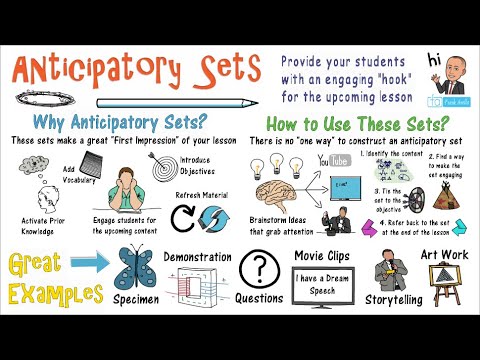
  2. Watch the video Anticipatory Sets (00:00-3:27)
    • “Anticipatory sets are often one of the most neglected yet most powerful tools in a teachers arsenal.”
      • 0:36 Activate Prior Knowledge
      • 1:22 Brainstorm Ideas that Grab Attention
      • 2:22 Examples Specimen

Evidence of Learning...

  1. Using what you have learned (and already know) about anticipatory sets, share (in 1-2 paragraphs) a very memorable lesson with a killer “hook” or anticipatory set. 
    1. Consider the following prompts:
    • Provide detail about the subject area, learning targets etc.
    • What made it so effective?
    • What (if anything) would you change if you taught the same lesson again?

All posted evidence

mystery grab bags

Something that has worked well with many grade levels for many different topics are "mystery bags" where student grab items and then we talk about what they pull out. For children with more sensory needs, putting items in a sensory bin has the same effect. It has helped get students excited as it has a mystery and game element. It also helps them have a more firm understanding of the vocabulary that will be in the lesson. By having these items out, it allows for many repeated exposures to the vocabulary as well. At the end of a lesson I've been surprised at how every age level wants to "play" with the items! 
lkilian 6 months ago

Anticipatory Sets

When I co-taught a third grade mystery unit for readers workshop, I began one of my lessons by setting up a small crime scene. I put some dead leaves, crumbs, and paw prints on the ground. Ultimately, my stuffed ground hog was the culprit, having "snuck" into the classroom uninvitedly. The lesson objective was for students to identify, speak, and write mystery vocabulary using their own good-fit mystery books. These vocabulary words included clue, suspect, and culprit. The anticipatory set got the students highly engaged in the mini lesson, led to the discovery of the vocabulary words’ meanings, and offered opportunities to practice using the words in context. If I taught this lesson again, I would be sure to include a share time at the end of the independent portion of the lesson.
cbuttino328 Over 1 year ago

Anticipatory Sets

Before teaching students how to infer when they read, I taught many lessons where they had the opportunity to practice inferring without actually reading any text. I recall using a variety of hooks to engage my students to infer and also learn that inferring is a skill we use in our daily lives. Some examples of hooks I used are: playing games, watching video snippets, using picture images and even dressing up. In first grade, we used the Headbanz game to practice inferring-it also was a great team-building activity. The video clips and picture images really allowed a great entry point for all my learners. The children also enjoyed when I dressed-up in a simple costume (wearing an apron, holding a mixing bowl). All of these hooks were highly engaging to my students and certainly put some joy into learning this tricky reading skill. These hooks also gave the students memorable experiences to connect further learning to. 
nbaker Over 1 year ago

Part 2: Anticipatory Sets

  1. One of my memorable lessons was when I was doing teaching small groups on anxiety. The anticipatory set I used was a big mindfulness exercise at the beginning of the lesson, having the students use all 5 of their senses. The activity engaged the  students into finding things they can touch, smell, taste, see, and feel. They were very engaged and did not even rally realize that they were actually practicing mindfulness until we got into the lesson itself and talked about the brain and how it functions when there is a perceived "danger" or a situation that they might perceive as anxiety provoking for them. After that, we talked about what we can do when we are feeling anxious, to work through those big feelings. We then reverted back to our earlier exercise and talked about how practicing a technique such as the fun activity they did at the beginning of group, can be used in moments of anxiety. The students were engaged, they learned more about how anxiety works in their bodies, and learned a mindfulness or coping tool that they can utilize when they start to feel those heightened emotions. 
mbarnum0711 Over 1 year ago

Part 2- Anticipatory Sets

I'm a special education teacher at the high school in a self-contained functional skills classroom.  My job is to help my students acquire the necessary skills to become as independent as possible, and problem solving is a life skill that will help increase their independence.  My students need ongoing practice with recognizing when they have a problem, determining how they can solve the problem (or asking for help to solve the problem), and then actually following through with the solution.  A memorable lesson for me was one that I was co-teaching with our speech pathologist on problem solving skills in real life scenarios.   Our anticipatory set included the two of us role playing various situations and the students having to identify what the problem was. They were immediately engaged and thought it was hysterical when one of us would drop our pile of books, or sit in the wrong seat, or spill our drink, etc.  The visual of us acting out the problems was an effective way to activate their schema, generate their interest, and get them engaged/excited to begin the lesson.  My students learn best and are more likely to retain information when it's presented in multiple ways, and when it is connected to their personal life/experiences. Role playing has been an effective strategy to help them make those connections and make the lesson more meaningful for them.
lfloreano Over 1 year ago

Part 2: Evidence of Learning

When teaching arithmetic and geometric sequences in Algebra, I commonly start the lesson with a phenomenal hook.  I pose the following question: would you rather be given $500 a day for the month of March (usually this is when the lesson is taught) or would you rather have $.01 on March 1st, $.02 on March 2nd, $.04 on March 3rd, etc.? In the second situation, the money will double each day until reaching March 31st. Students will immediately gravitate toward the first situation: earning $500/day. But then I request proof. I ask them to grab their pencil, pick up their calculator, and start calculating how much money each scenario would give them.  Earning $500 a day for the month would accrue $15,500.  The second situation that begins with a penny doubling in value will give them over $10 million! They are always stunned when this happens! This purpose of this hook is to show them the power of exponential growth and how to easily build a geometric (exponential) equation. I would not change this lesson at all!
mskurzewski Over 1 year ago

Anticipatory sets

In a small group pull out setting with entering students we were learning about plants.  To start off the plant life cycle I presented students with various seeds that they could hold and examine.  I asked what these were. Most students answered in Spanish “semillas”.  We identified semillas as seeds in English.  Then I asked if all of them were seeds, and if so why did they look different?  Then we moved into reading a nonfiction book about seeds.  Some of the seeds I had presented students with were identified in the book (bean, sunflower) so we identified those seeds.  By the end of the reading students were able to identify that the seeds were different because they came from different plants.  Realia is an amazing anticipatory set for ELLs.  It makes the lesson more concrete for students by seeing the real world application.  We did plant seeds later on, but in the future I may plant one of each of the seeds we examined so we could see if the sprouts were also different. 
melissa-erikson Over 1 year ago

The Importance of Anticipatory Sets

Share a memorable lesson with a killer "hook" or anticipatory set. 

Anticipatory sets are a great way to engage students in the lesson. Research has shown that anticipatory sets can have a positive impact on student learning. "When students are actively engaged at the start of a lesson, they are more likely to pay attention. 

I remember one such lesson where I devised an anticipatory set that had the students hooked. I was teaching my first graders a series of skills to help them become fluent readers. One of the fluency skills focused on matching your voice to the feelings of the characters. I told the students that this would make their reading come alive, like watching a movie in color. I then showed them a clip from the Wizard of OZ. I instructed them to watch Dorothy's reaction when she opens the door of her house, to find a world in color.   

After watching the clip I connected it back to the lesson objective by saying: When you match your voice to how the character is feeling, that's like watching a movie in color. 

After demonstrating and teaching students through the "I do, we do, you do" method, I closed my lesson by connecting once again to the anticipatory set. I concluded with: "Now you know how to add color to your characters. Not only by matching your voice to their feelings but to their personality too. 

I used this idea of reading in color to help students self evaluate. When they matched their voice to the feelings of the character, they were reading in color. When they neglected to apply the characters feelings, they were reading in black and white. 
veronicatruskey Over 1 year ago

Anticipatory Set Reflection

I’m very lucky in that my curriculum relates to real-world situations. A lesson that stands out for me is in my Marketing class when we talk about the basic concepts of Marketing and how they apply to the real-world businesses. Students learn about the 4P’s and are asked how companies use the elements to reach their target audience. 

I start with the anticipatory set of “What is your favorite brand?” to get students thinking I display logos of popular brands on the white screen. Students are provided with a post-it note and asked to write the name of their favorite brand and explain why they like it. Once completed students affix their post-it near the logo for their brand. After students have returned their post-it we have a class discussion regarding the brand choices. Often student responses include comments about quality, price, style, advertising, social media presence or about how popular a brand is currently. This conversation lends itself to discuss how the brands have successfully marketed themselves to become a favorite among consumers. 

The purpose being that we have now generated an interest in what businesses are doing and how they relate to the lesson at hand so students are better prepared mentally for the lesson. I do reflect on lessons regularly and as a result the logos presented to students do change based on what’s popular during that year, so the material is easier for students to relate to.
melissa8 Over 1 year ago

Discovery through investigation

For a first-grade science lesson on light and sound energy, I created a memorable anticipatory set by changing the classroom into a mini "light and sound exploration lab." As the students entered, the room was darkened, and I played a variety of sounds—ranging from the hum of a flute to the sudden clap of thunder—over the speaker. Then, I used a small flashlight to create patterns of light on the walls, occasionally shining it through different colored panels to create a light effect. The students were immediately intrigued by the combination of sounds and the lights, which certainly sparked their interest.
I gathered them in a circle and asked, "What do you think is making these lights and sounds?" This question led to a community circle discussion where students eagerly shared their ideas. I then revealed a "mystery box" that contained various objects related to light and sound, such as a small drum, a tuning fork, a prism, and a flashlight. Each student had a chance to pull an item from the box, sparking their interest and setting the stage for the lesson. This anticipatory set effectively peeked their attention and set a playful, exploratory tone for the lesson, making the concepts of light and sound energy exciting and accessible for my little learners.

jessica12 Over 1 year ago

B#5 Part 2 - Anticipatory Sets

miausb14 Over 1 year ago

Erman Evidence Part 2

When considering the prompts & the info about anticipatory sets, a lot of the hooks in my lessons that came to mind came from science lessons that I taught. I teach 3rd grade and our science lessons not only focus on developing the kids’ Scientific Practices, but simultaneously developing their literacy skills. In order to do so, there’s a lot of balance & transition throughout a lesson. It takes a lot of practice to make sure the objective doesn’t get lost throughout the teaching. One awesome thing about science is that it lends itself to an engaging anticipatory set. 
One lesson in particular that stood out to me with a great ‘hook’ was during the beginning of a Physical Science unit. I was introducing the cross cutting concept of Cause & Effect and the Scientific Practice of Problem Solving & Asking Questions. The kids were presented with a challenge to get a coin into a cup without touching the coin or cup. I presented the problem to the students and didn’t offer solutions. I modeled a few ways I thought I could be successful in the challenge (I purposely failed) but just the materials alone and a hands on ‘challenge’ presented to the kids was enough to have them locked in. If I could do it differently I might start by slowly revealing the materials just for dramatic effect & because I love to have fun with the kids. But overall, the hook has been successful in pulling the students in each year that I’ve done this so I’m excited to keep going with it!
elifweiser Over 1 year ago