SBAC Digital Library

Searching the Library

Only editable by group admins

  • Last updated December 7, 2017 at 2:20 PM
  • Evidence visible to public
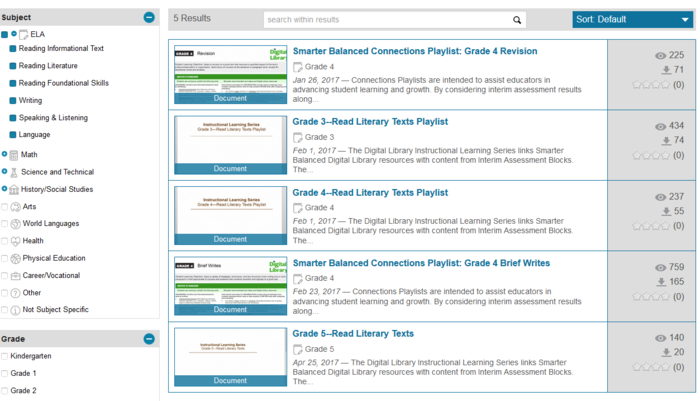
After reading and understanding the materials on searching the digital library download a resource that is specific to your content and grade level. Then write a short description of the lesson/s you downloaded and how it can help teachers at your grade level.

All posted evidence

Using Textual Evidence to Write and Present an Academic Summary

 This 11th grade lesson plan focuses on close reading strategies, annotating, and ultimately completing a rhetorical precis. Students will read the article “The Right to Fail” by W. Zinsser and watch a youtube video on famous celebrities who have experienced failure before success. Then, they will annotate Zinsser’s article, complete a quick write, and locate claims in order to produce their rhetorical precis. This lesson will help teachers at my site to scaffold the close reading skills emphasized by the Common Core curriculum in order to teach all students how to close read, find textual evidence, and then incorporate the information into an academic summary analyzing the author’s purpose.
agroty Almost 8 years ago

Sentence Stems for Establishing Sources in Argumentative Writing

 This activity will primarily be used prior to asking students to write argumentative essays that require them to draw evidence from either non-fiction or literary texts. This task is designed for 9th, 10th, or 11th grade students.   Teachers will be able to use this to accomplish 6 major skills sets in anchoring research into argumentative writings: 1. To introduce the concept of establishing sources. 2. To teach the necessary elements of establishing sources. 3. To provide models of properly punctuated, thoroughly established sources. 4. To offer students the opportunity to practice establishing sources. 5. To elicit evidence of students’ ability to properly punctuate and thoroughly establish a source. 6. To provide the teacher with a quick, easy formative assessment.
chendr Almost 8 years ago

Lesson: Grade 7 Expressions and Equations

The lesson I chose to download was on expressions and equations in the 7th grade for students wanting to solidify their skills. This resource gives you eight skill areas to focus on including but not limited to equations, formulas, integers, distributive property and graphing inequalities. I specifically chose this because I teach the accelerated course 2 and can always use resources for students to practice and perfect their math background knowledge. There are several ways it can help the 7th grade team. There are practice performance tasks that include real-life problems that will engage the students and help with writing in mathematics. Finding activities like this in the current curriculum is not always easy, so this would be very much appreciated. They also offer different activities for writing and identifying Equivalent Expressions such as Popcorn Sale  that teachers can offer to strengthen skills while enjoying the practice. Having this all available through the digital library, and accessed on the iPads like they are required to test on, is so valuable. It will help the 7th grade team work together through a viable source of resources that everyone can be successful at.
amypitotti Almost 8 years ago

Main Idea and Supporting Details

Students tend to struggle with finding the main idea and identifying the supporting details. The lesson that I found can also be used as a formative or summative assessment. You type of paragraphs sentence by sentence and cut each sentence out. Students will have to read each sentence and determine which sentence is the main idea and which are the supporting details. One thing I liked about this lesson is that it can be differentiated easily by increasing/decreasing the text complexity. It can also be adapted to fit whatever topic is being taught in class. They also suggested having students partner up and explain their reasoning to another student after they have identified the main idea and supporting details. This is a great way of getting students to engage in academic discourse and also work on listening and reasoning skills.
janis311 Almost 8 years ago

Math - Grade Level 3rd-5th Understanding Division 60-75 minutes duration

CCSS 3.OA.2
Interpret whole-number quotients of whole numbers, e.g., interpret 56÷8 as the number of objects in each share when 56 objects are partitioned equally into 8 shares, or as a number of shares when 56 objects are partitioned into equal shares of 8 objects each.

We are currently working on division problem solving.  We understanding equations, fact families, and have a surface level understanding of the relationship between multiplication and division.  I am looking forward to a lesson of this nature that takes the students understanding to a deeper level.  The word problem gives the students an opportunity to find connections between numbers and how they relate to one another within the concepts of multiplication and division.  

The problem:  Samantha has _____ apples.  If she puts _____ apples in each pie, how many pies can she make?  (78,6)  (108, 6)  (216, 6)  (432, 12)

Aspects of the lesson I appreciate:
There are questions listed that help the students begin to of predict what the answer might be without requiring one exact answer at the beginning of new understanding.  The lesson encourages partner talk and sharing.  The key questions ask for additional possible solutions which encourages continued thinking and not just one way of finding a correct answer.  There are also questions suggestions for students who are struggling.  Finally, the author of this lesson reminders the teacher of key ideas to emphasize and ideas for using formative assessment to plan the next lesson.

keepquilting Almost 8 years ago

peer to peer assessment strategy

The lesson I choose was the peer to peer assessment strategy using post it notes. On the board I would display three differentiated math problems.  For example, finding the area of different shapes by having to break apart the shape into rectangles.   Once they figure out the answer they write their name on the back of the post it note and take it back to the board .Then the student chooses another question. Once another student workouts out the problem, they have the opportunity to compare and check answers with other students.The conversation that takes place in the classroom during the exchange of answers allows them to explain their thinking. This will help teacher at my grade level by facilitating a deeper thinking of Area and having students look and challenge peers' answers to a problem.
aguevara Almost 8 years ago

Posted Image

juliedmunds About 8 years ago