
Choose YOUR book, Book Study 2025-2026

Book Snap #7 Lessons from the book

Only editable by group admins

  • Last updated July 23, 2024 at 9:19 AM
  • Evidence visible to public
You can snap any way you'd like, but it must include... -pic of the text -specific line or line that you draw our attention to (highlight, underline, etc.) -emoji -text annotation -audio recording that explains the book snap at an even deeper level

All posted evidence

Posted Image

talia-gallagher 9 months ago

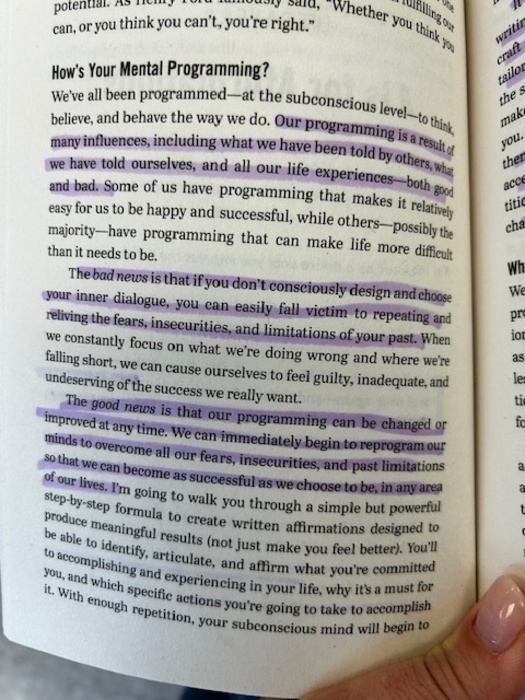
Mental Programming..

rebeccamc 9 months ago

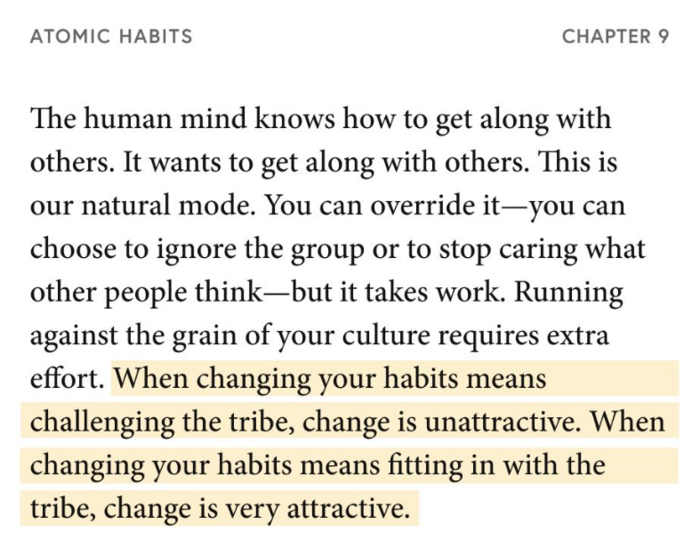
It is hard to go against the tribe. Find people that are like minded that share your goals and values and help you be who you want to be.

eileenjroth04 10 months ago

The Power to Transform

Chapter 7, The Power to Transform, was jam-packed with wonderful explanations and ideas.  It related the reading power of transforming to the power to synthesize. (This was helpful for me because I had previously read Strategies that Work and it discusses this same concept.)  The power to transform refers to the idea that books can have an impact on how we think about ourselves and the world around us.  Gear explains that she chose the word transform because she felt younger students might be more familiar with the word and its meaning than the word synthesize.  
 
I found Gear’s comparison of summarizing versus synthesizing very informative.  She explains that summarizing is like two-dimensional reading and it makes information from the text smaller.  The power to synthesize on the other hand is 3 dimensional in that the key points from the text, plus the reader's thinking, are used to create a new thought or idea.  She goes on to stress the importance of teaching students the power to transform in order to create critical thinkers.
katie-jadhon 11 months ago

"Perhaps the most important advice that we can offer is to avoid escalating situations whenever possible." pg. 78

This is such prudent advice not only in the classroom, but in life.  "...teachers can respond to problematic behaviors along a continuum based on the severity or intensity of the issue..." pg. 78. Smith, Fisher, and Frey recommend five levels of intervention: 
1) Looking - making eye contact with the student or using a simple gesture
2) Naming - talking quietly to the student, identifying the problematic behavior
3) Questioning - ask the student what they should be doing at the moment
4) Commanding - informing the student what they need to be doing instead of the current behavior and may not consequences if needed
5) Directing - physically preventing the behavior, such as separating students
Not one if better than the other, they are just measured responses that fit the needs of the situation, always with de-escalation in mind.
rachel-knapp 12 months ago

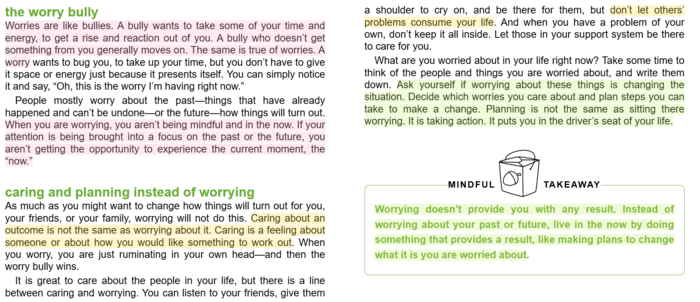
Our students must be taught the difference between worrying and caring about something. Many of our students needlessly worry about little things that can never be changed instead of spending time caring about themselves and others, and planning on how to change things in the future.

cpiazza About 1 year ago

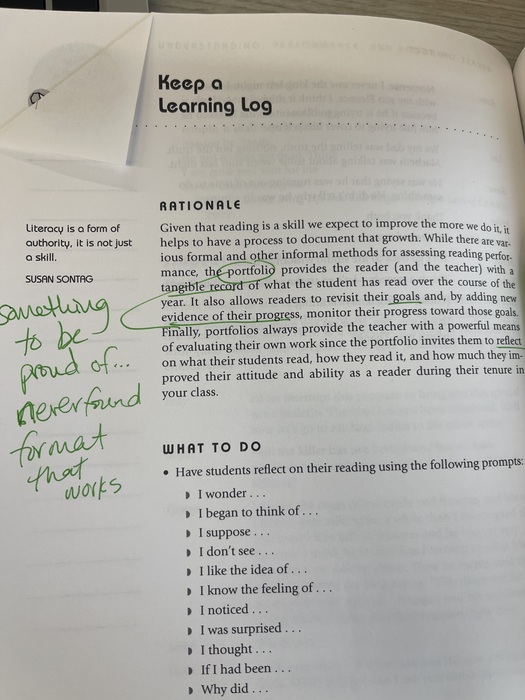
Students love when I post their work, I want some way for everyone to look back and be proud, haven't yet found a format that works..

lauren-mccarthy About 1 year ago

p 216 Marcus Aurelius: "The things you think about determine the quality of your mind. Your soul takes on the color of your thoughts".

Marcus Aurelius had great wisdom about the problem today. Social media and information from our phones have changed our daily thoughts. They can cause us to feel negatively about ourselves and the world around us. This information (and misinformation) is at our fingertips and is so often in our daily thoughts. Those constant unsettling thoughts can then lead to personality changes (especially in our youth in critical stages of development). 
christinamalara About 1 year ago

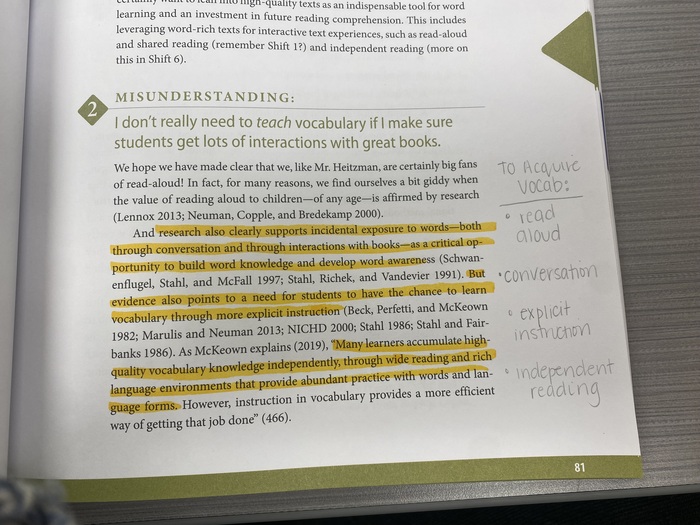
Move 6: Focus on Meaningful Fluency Practice and Move 7: Improve Comprehension by Developing Vocabulary and Background Knowledge

Move 6: We want our students to be able to read at a reasonable rate, quick enough to keep moving along at a fluent pace, but so quick that their comprehension suffers. Strong readers have mastered the balance of fluency, accuracy, and rate. I did learn a new term that I'd never heard before: Prosody. Prosody is a term that encompasses all the things a good reader does naturally while reading fluently -- expression, phrasing, intonation, and volume.

Move 7: "Researchers have known for years that the most important factor is good reading comprehension is how much vocabulary and background knowledge the reader has on the subject. Reading comprehension is not a single skill, but an orchestrated product of a set of linguistic and cognitive processes." Students must be able to read a text fluently and accurately in order to comprehend, and doing the aforementioned relies upon a strong foundation of reading skills dating all the way back to where reading instruction begins in Kindergarten, with letters and sounds. I am very proud of the work we do in K. We have the tools, training, and experience to build a strong foundation for our students to become successful readers.
carrie-callan About 1 year ago

Page 239

" In the next chapter, on what schools can do, I'll make the case that all schools, from elementary through high school, should go phone-free to improve not only mental health but academic outcomes as well."

I do not work in the high school nor do my own kids attend the high school, but I like how this year the high school has created a no-phone policy during the school day. My oldest will be at the high school in 4 years and when he is there I will be glad that he can't have his phone on him during the day. They are a distraction. You are sitting in class and your phone vibrates, now you want to look at it and see who has messaged you. Now all you can think about is that message you were just sent instead of what the lesson is that your teacher is talking about. 
When that bell rings at the end of the day, you know kids are going right to their locker to grab that phone, turn it on, and check what messages they have received. With the no phone policy, for at least 6 hours kids will not be on their phones checking all their social media apps and messaging with one another.
I am happy to hear that many schools are implementing this policy.

michelle-hogan About 1 year ago

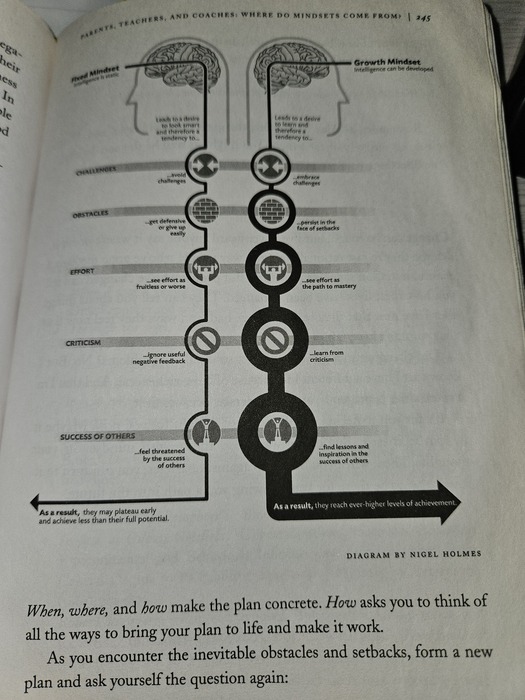
Maintaining the mindset- summary to go with the picture

Maintaining change will be important to continue nurturing the Growth mindset. The image I included with this snap, is a visual that Dweck provides to her readers so they can continue to understand how the brain works and remind themselves to continue forward with the Growth mindset. Success in one area doesn't mean I have achieved the Growth mindset. It is a practice to maintain and keep working on. This will be important to remember when dealing with students. Once they exhibit some Growth mindset, the work is not done! We can't just sit back and let it go. We have to keep up with the guiding questions, self-reflection, and focus on effort (not results). It is very easy to slide back into old practices and habits. The visual will help develop a daily self-check in to make sure I am on continuing on the path of the Growth mindset. The visual will help anyone- teacher or student. 
valerie-indolfi About 1 year ago

The Growth of Mindset and Self-Control

valerie-indolfi About 1 year ago