Choose YOUR book, Book Study 2025-2026

Book Snap #5 Lessons from the book

Only editable by group admins

  • Last updated July 23, 2024 at 9:19 AM
  • Evidence visible to public
You can snap any way you'd like, but it must include... -pic of the text -specific line or line that you draw our attention to (highlight, underline, etc.) -emoji -text annotation -audio recording that explains the book snap at an even deeper level

All posted evidence

Posted Image

talia-gallagher 9 months ago

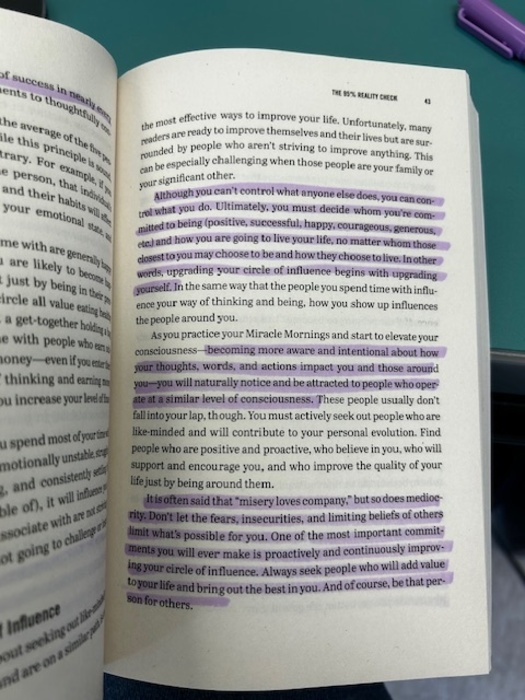
One of the most important commitments you will ever make is proactively and continuously improving your circle of influence.

rebeccamc 9 months ago

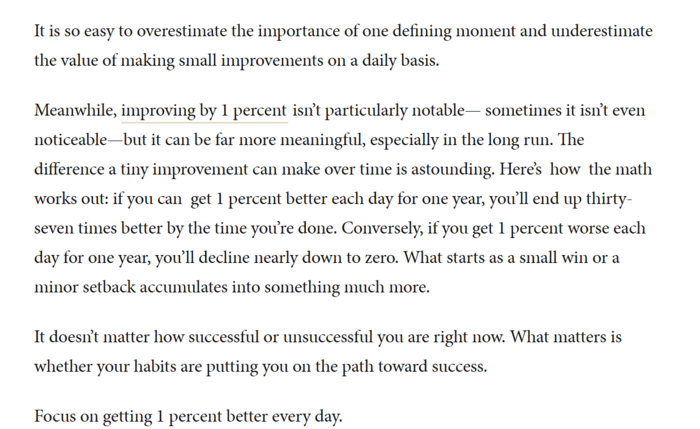
I love this part of the book- improving just a little bit and being consistent with tiny improvements is meaningful and important.

eileenjroth04 10 months ago

The Power to Question and the Power to Visualize

“Reading beyond the Surface” was a key phrase in chapter 4.  It discusses how teachers can model the difference between literal and inferential, or “quick questions and deep thinking questions.” 

Chapter 5 discusses the power to visualize.  There was a lot of highlighting going on for me in this chapter.  I often ask my students what they are seeing in their heads when they are reading. However, I realize now, that I don’t model it nearly as much as I should. This chapter provided wonderful visualizing exercises and activities I can do with my students, and just like previous chapters, it provides lists of books that I can use for this skill.   
katie-jadhon 11 months ago

Six considerations that allow student-to-student interactions to prevail.

1) Meaningful and complex tasks - students need to understand a task on which they are working (of course!) otherwise they will lose interest and talk about other things to their peers.  It must also be complex enough that it requires frequent discussion in order to figure out the challenge.
2) Joint attention to tasks and materials - modeling, providing videos for students to see other students appropriately working together (they way they speak to each other, their body language, etc) and checklists are good ways to train students in this part of a project.  A sample checklist could include: maintained eye contact with the speaker, remained focused on the lesson, regularly leaned into the group rather than backing away, used facial expressions to convey interest, questioning, or agreement.  
3) Argumentation, not arguing - this involves students making claims, offering evidence, seeking clarification, offering counterclaims, and reaching consensus or identifying points of disagreement.  This has to be taught, modeled, and practiced.  
4) Language Support - we need to provide students multiple ways to express their ideas and opinions.  This could look like sentence frames, teacher modeling, word walls, audio devices, collaboration with peers, verbal signals, and speaking in respectful tones.  
5) Group Size - experts use a combination of whole-class and smaller configurations of two to five students.  Match the group size to the task at hand and to the needs of the students.  
6) Teacher's Role - teachers should question, prompt, cue student thinking.  They need also be aware that their comments can enhance or damage student self-esteem.  

rachel-knapp 12 months ago

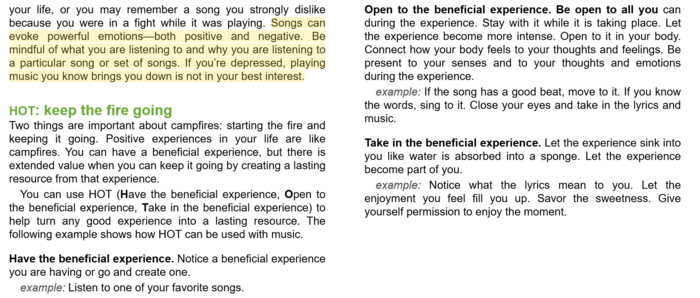
Yes, music has such a powerful connection to our emotions. They can change how we're feeling in the blink of an eye. Music is such a huge part of our student's lives. They need to begin to understand music's impact on their day.

cpiazza About 1 year ago

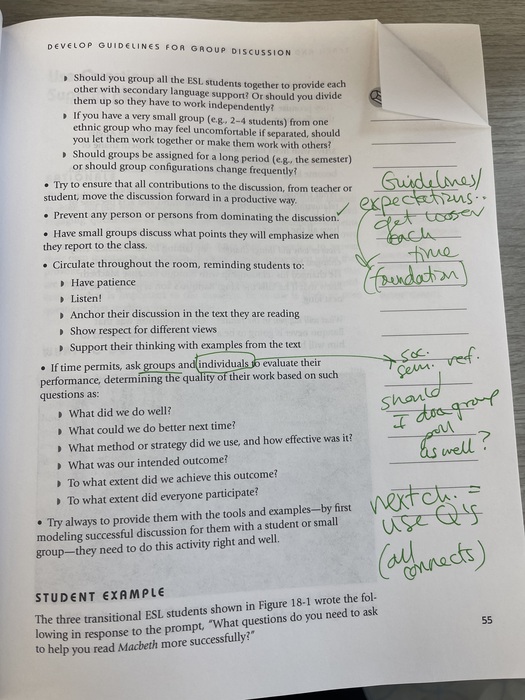
Made me consider adding a whole-group assessment on top of the individual ones students do after my Socratic seminars

lauren-mccarthy About 1 year ago

p. 120-23 The First Foundational Harm is Social Deprivation...

I feel like as a teacher of first graders, this one was spot on professionally. I think that our children are already getting less unstructured socialization than ever before and it really shows. Kids do not know how to problem-solve, conflict-resolve, turn-take, etc without constant adult intervention. Some parents try to provide this through scheduled organized sports and activities, but it doesn't replace free play, which is scarcely provided at school. I think the worst thing we can do for kids is take away more of this critical part of development. 
christinamalara About 1 year ago

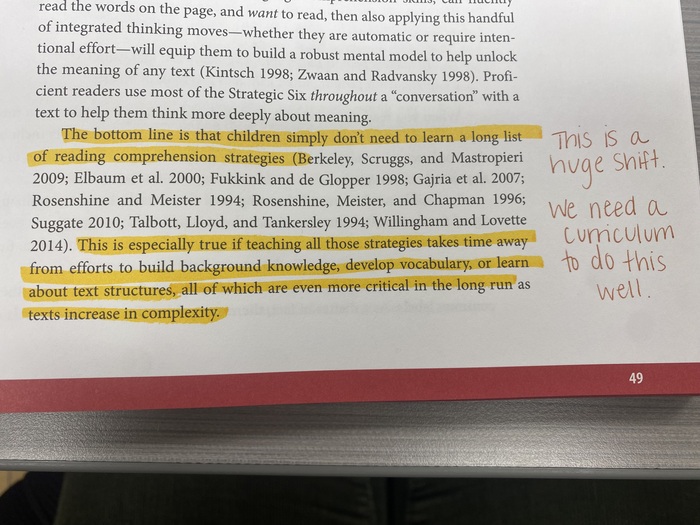
Move 4: Use Decodable Text Instead of Predictable Texts With Beginning Readers

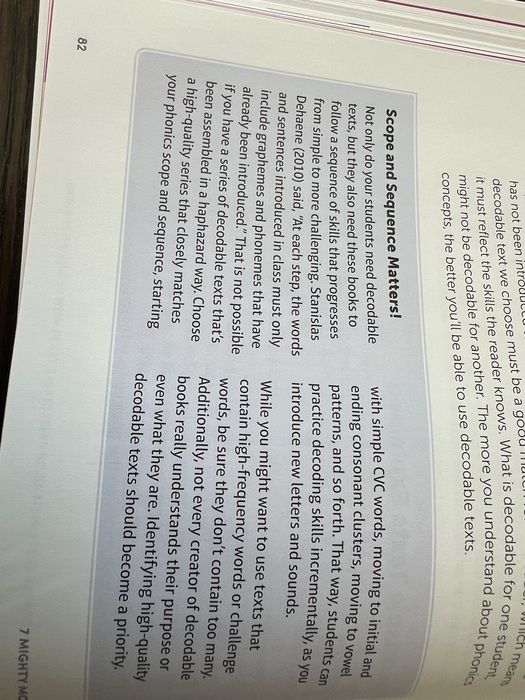
This chapter was about replacing predictable texts with decodable texts. In doing so, we are ideally removing the word/pattern memorization and guessing that occurs when a child "reads" a predictable text. Instead, decodable texts force a reader to utilize sound-symbol correspondence and do the work to read words, in such allowing the reader to apply what they've learned in their classroom phonics lessons. Scope and sequence matters when using decodable texts to extend your instruction, see. pic from page 82.
carrie-callan About 1 year ago

Move 4: Use Decodable Text Instead of Predictable Texts With Beginning Readers

carrie-callan About 1 year ago

Page 120 -- Social Deprivation Page 123 -- Sleep Deprivation

Harm #1Social Deprivation -- " Children need a lot of time to play with each other face to face, to foster social development." I am lucky that we live in a neighborhood with kids the same ages as my kids. We also have neighbors across the street with kids the same age and we have become like family to one another. My kids go over there and their kids will come to our house. Just yesterday the two boys were over and my younger two were playing with them inside building magnets. Then the four of them went outside where my older son and his friend were shooting hoops and next thing I know I look out the window and all 6 of them were running around playing hide and seek. I loved it! We live in a great neighborhood for in person social interactions with kids and are lucky. Even in the winter months, they may not want to be outside for long because of the temperature but they will play inside with the magnets, nerf guns, monster trucks, etc. 
When it comes to Harm #1 listed in this book I feel for the most part my own children do not have social deprivation like other kids may have.

Harm #2 Sleep Deprivation -- "Teens need mlore sleep than adults -- at least nine hours a night for preteens and eight hours a night for teens." With my own children most nights they are getting the amount of sleep they need. Weekends we will let them stay up little later, especially if we do not have anything going on the next day so they have the chance to sleep in if they want. 
Right now I have an app on their phone where I can set time limits for apps and set downtime for when the phone will turn off and turn back on. I have caught my son trying to take the phone to bed so he can watch his baseball and basketball youtube videos under the cover. He now knows that the phone will lock at a certain time so when he goes up to bed he doesnt try taking the phone anymore. They also ask for a TV in their room and have offered to buy one. We tell them no. Neither myself or my husband grew up with a TV in our bedrooms and even today we do not have a TV in our bedroom. In our household I feel we are doing a pretty good job wiht bedtime and no screens in their bedrooms.
But I see if with students, they come to school tired and you ask them what they were doing the night before and they tell me they were up late playing video games or talking with friends on their phone. They will say they need their phone because its their alarm, but a phone can be in downtime mood and the alarm will still go off. Why don't parents of preteens and teens shut the phones off at night so that their kids don't have that temptation to go on and instead when they get into bed and their head hits the pillow they go to sleep? 
michelle-hogan About 1 year ago

excerpt from "Parents (And Teachers): Messages about success and failure" (Mindset The New Psychology of Success by Dr. Carol S. Dweck)

" Parents think they can hand children permanent confidence- like a gift- by praising their brains and talent. It doesn't work, and in fact has the opposite effect. It makes children doubt themselves as soon as anything is hard or anything goes wrong. If parents want to give their children a gift, the best thing they can do is to teach their children to love challenges, be intrigued by mistakes, enjoy effort, and keep on learning." (Dweck 176-177)

I want to apply this to homework completion for my own children and my students. Homework completion is a challenge. Students don't want to read on their own, and it seems like the same students give minimal- or no- effort on their assigned work. I always make a point of telling the students that I will never waste their team with meaningless homework. All h/w in my class has value. Now, I want to begin to give praise on the time and energy that went into the work. I will also use this with my own daughter. H/W completion is a struggle at home. She is 6, almost 7, and hates homework.  Here's a phrase I'm going to borrow right from Dr. Dweck: " That homework was so long and involved. I really admire the way you concentrated and finished it" (178).  Another one: " We all have different learning curves. It may take more time for you to catch on to this and be comfortable with this material, but if you keep at it like this you will." (178). Perhaps modeling the growth mindset in my classroom and at home, will help make h/w a slightly less onerous task for some. 

Sadly, I am guilty of praising my own children using fixed mind-set phrases. I was operating under the belief that I was giving them the gift of self-confidence, and now, I see how mistaken I was. Luckily, my own children are still in elementary school so I can start to use the phrases that reflect a growth mindset. 
valerie-indolfi About 1 year ago