
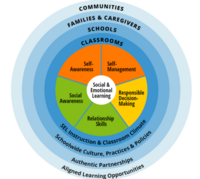
The CASEL Framework

Social Awareness

Only editable by group admins

  • Last updated September 26, 2022 at 7:50 AM
  • Evidence visible to public
Describe a key learning about Social Awareness Share one specific way you are encouraging social-awareness in your classroom.

All posted evidence

Social Awareness

Social Awareness is understanding how other people think and feel.  It is important to be able to empathize with others to understand their perspective.  In my classroom, I believe we are always working on social awareness when we work in partners or groups.  When working with other students to solve a problem students need to take both their perspective and those of others into consideration, to come to a solution.  Over time they learn how to understand how other people think better.  
melissa7 Over 1 year ago

Social Awareness

Expressing Gratitude- I was brought up in a "please" and "thank you" household and am very adamant that everyone should be polite individuals no matter their circumstances. I see a sense of entitlement from students in my classroom and when students demand "I need a pencil" or "You didn't give me the packet pages I need," I try to rephrase what the student is saying from a polite standpoint and request a gracious answer when they receive what they "need." For example, just yesterday I printed a form for a student and he began walking away from me without acknowledging that I did him a favor. I requested he come back to my desk and ask him what might he say to a person who has done you a favor, to which he said "Thank you." Another example was when we took our students on a field trip, I waited for all the students to get off the bus and heard one out of about 25 students say "thank you" to our bus driver. I made a point to address the students on the way home and relay to them how important it is to acknowledge the people who do things for us, like get us to our location safely. Students aren't malicious nor do they purposely act this way, but it is important to remind students how important manners are in their lives. 
ebonomo Almost 2 years ago

Social Awareness

Social awareness is the ability to respond to social situations appropriately, read social cues and judge the appropriateness of ones own response to others actions. Social awareness could be considered how well someone 'reads the room.' Social awareness is an important skill to master as it is a key factor in establishing and keeping strong and positive relationships. Further, social awareness is a skill that is essential in many professional workplaces. Students with low social awareness often struggle to interact with others appropriately and can be picked on for their poor social responses. Teaching social awareness is not something that I currently incorporate into my classroom instruction. After learning more about social awareness and its impact on students well-being I do plan to begin integrating teaching social awareness in the classroom. The techniques that I plan to use are role playing and perspective taking of others (my hope is that this helps students level of empathy). I also would like to incorporate active listening activities to help strengthen students ability to listen with intention and respond kindly.   
megan-turvey About 2 years ago

Social Awareness

Social Awareness is thinking about how others feel and understanding their perspective.  Students need to be able to understand and display empathy to others. 
In the classroom, we can read books and discuss how characters feel and their responses to different situations.  We then talk about how they would respond if they were that character.

rene-carone Over 2 years ago

social awareness

Social awareness… being able to “get outside” of yourself and understand and appreciate others and see things from their perspectives and experiences.
In class: “Showing concern for the feelings of others” is something that pops up in my classroom often. Daily, I check in with the students to see how they’re doing and if they say “well” or “happy” I often just let it go, but if they have a different response (“sad” or “excited,” say), I will follow up and see if there’s something more that we need to know. This, I believe, helps us all be aware of what the others in the class are feeling that day and it may, hopefully, help us to temper our behaviors towards them. We saw this “in action” at lunch recess the other day – one of the students was having a rough day and it was obvious that they were upset. As the other students passed this student (the others were doing laps around the track), several of them stopped to check in on the one student, offer words of support, a quick back rub, etc. It was so comforting to see that the other students cared about this classmate who was having a rough go of it that day.
bethany-turo Over 2 years ago

social awareness

My key learning about self-management is EMPATHY. Kids need to learn to see other perspectives and truly respect differences. This can be a tough one for egocentric first graders! I try to build our classroom rules based on being understanding of the feelings of others. I try to read literature (Scholastic has been great for this reason), which exposes kids to other cultures and perspectives. I also use the elements of social awareness during conversations of conflict resolution. 
christinamalara Over 2 years ago

Social Awareness

I encourage social awareness in my classroom daily.  I am constantly reminding, even to high school students, that kindness and manners matter.  Treat others the way you'd want to be treated.  If I hear a comment that may be unkind I ask that student if they think that was a nice thing to say and how they would feel if someone said that to them or someone they cared for.  Most of the time the answer is no, it wasn't kind and an apology is given.  I try to use each of these moments as teaching moments.  I also try to remind when the moment arises that we are all different and unique which makes the world so beautiful, so embrace everyone's differences and accept them.
abrownsell Over 2 years ago

Social-Awareness

Social awareness allows us to understand how another person is feeling.  It is the ability to empathize with others, express gratitude, and have a sense of belonging to one’s family, classroom, school, and community.  Often students come to talk to me about issues other than math problems.  I encourage my students to see other students’ perspectives about various issues that arise.  I model the behaviors I want my students to have.  Therefore, I display empathy, compassion, and gratitude in my classroom every day.
kfoster615 Over 2 years ago

Social Awareness

Social awareness is understanding others around you and empathizing what they may be going through. It is trying to understand different backgrounds and cultures.

In November I really try to drive home that not everyone has a family to celebrate holidays with or the things that we may take for granted. Throughout the month and into December we donate hats and mittens, pies, toys, and other items that people may need. We had lots of questions about why we were collecting toys this year, once my students realized they were donating things to children who don't have much, they were so happy to be able to help, even a little bit!
rebeccamc About 3 years ago

Social awareness

Social awareness is the ability to understand others’ perspectives, be aware of other people's feelings, and be able to demonstrate empathy and compassion.  I encourage social awareness in my classroom by helping my students see what others are going through.  We talk about how others might react to certain behavior and why they might act that way.  I try to encourage my students to treat others fairly and how they would like to be treated.
cpiazza About 3 years ago