
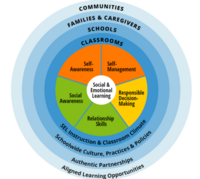
The CASEL Framework

Self-Management

Only editable by group admins

  • Last updated September 26, 2022 at 7:50 AM
  • Evidence visible to public
Describe a key learning about Self Management Share one specific way you are encouraging self-amanagement in your classroom.

All posted evidence

Self Management

I consider self management when the student takes ownership of their learning, by showing initiative, goal setting and perserverance.  I try to encourage self management by the homework readings I give.  I try not to "assign" them, but rather say things like - oh, how I love this book, or chapter, or passage - I'd love to chat about it with you tomorrow after you have read it.  I try to make it sound like they "chose" to do the assignment.  I also give them books with several stories in it (all with the same theme).  I love when they come in and say - Hey, I read ahead to this story and ....... It really shows me if they are taking ownership of their own learning -  even as a little one.  :)
joan-loughran 3 months ago

Self-Management

Self-management, as defined in this badge, includes the ability to regulate and express emotions thoughtfully, persevere to overcome obstacles, use stress-management strategies, use organizational skills, maintain attention, and practice self-compassion. Self-management is an important skill for children and adults alike. It is important to teach children these skills so they can succeed as adults.  I encourage self-management in my classroom through the use of procedures and routines.  Through this structure, students are part of a chaos-free environment, manage their time, and know what is expected of them as far as behavior and completing assignments/participating. 
jsherman 7 months ago

Self Management

Students need to be in the right frame of mind to learn and to do their best. Without impulse control and emotional regulation, learning can be very difficult.  There are many intrinsic as well as extrinsic distractions that may make a student feel uncomfortable and dysregulated. This can cause an exaggerated response to thoughts, feelings and behaviors. Students need to learn regulation strategies that will calm their feelings and put them in the best state for learning.

I address self management through the use of mindful breathing as a self-regulator.  I have a flower and a birthday candle in my room. Students practice taking deep breaths by 'smelling" the flower, then purposefully exhaling by pretending to "blow the candle".  Students like using the actual objects  to help them calm down. 

anna77 8 months ago

Self-management

Self-management means staying in control of your feelings, focusing, and making good choices. It helps students stay organized and handle problems. In my classroom, I use daily agendas and project rubrics to help with this. The daily agenda shows what we’ll do each day so students can stay on track. Project rubrics explain what’s expected, so students know what to do and how to do their best. These tools help them stay responsible and work on their own.
greg-soposki 9 months ago

Self-Management

Self-management works closely with the component of self-awareness as we learn to regulate and control our emotions to produce productive outcomes instead of a negative result. Motivation, perseverance, and discipline are closely related. It’s important to provide goals for students to help keep them motivated regardless of their ability. Also, It’s important to be consistent when striving to reach a desired goal. Being organized and realistic can help students become successful.
I believe that physical education and team sports offer a great opportunity for students to improve their self-management skills. When playing sports, students are encouraged to play with passion, however, if their emotions get out of control, they or their team will be penalized. I feel that having goals is important for everyone. During track and field, every student is striving to reach their goal which is to improve on their personal best score. We call this a “PR” short for personal record. This is very important as it helps motivate all students on the team regardless of their ability.

kevin-bovi 10 months ago

Self Management

Self-management is the ability to control one's emotions to achieve goals. It includes persevering through challenges and coping with stress. In my classroom, I try not to infiltrate toxic positivity but rather encourage my students to take action for positive change. What this could look like is if my students feel overwhelmed by a challenging assignment, I discuss options on what we could do to resolve it.
fdambro 11 months ago

Self-Management

Self-management involves the ability to effectively regulate one’s emotions, thoughts, and behaviors in different situations. It is about managing stress, controlling impulses, and working towards personal and academic goals. 

To help with self-management in the classroom, time is set aside for my students to set personal goals.  These goals have given my students a sense of ownership over their learning and growth. We regularly review these goals and discuss the progress they are making.

Goal-setting can be difficult for many students at first, as they often aim too high right away and easily get discouraged. I try to guide them into making goals that are attainable with a little perseverance and self-discipline. We discuss what is necessary for them to achieve their goals and what steps they will take to do so.       
katie-jadhon 11 months ago

Self-Management

A key learning about Self-Management is that it helps students control their emotions, thoughts, and behaviors, especially in difficult situations.  It’s about staying calm, setting goals, and following through with them, even when things get tough.  

A way to encourage Self-Management is to count to 10 or take lap around the building when they start to feel upset or overwhelmed.  I also encourage them to set personal, daily goals like staying focused/awake during instruction and finishing a task on time.
agilland About 1 year ago

Self Management

Self-management means taking responsibility for one’s actions and well-being, including managing emotions and stress for better decision-making. In my classroom, I encourage students to make positive choices and help create a calm atmosphere. Many of my advanced 7th graders struggle with this, as they’re used to being right, often calling out answers, and have rarely faced academic challenges before. Given the fast pace of the class, I emphasize self-management strategies and open communication, inside and outside of class, to help us set achievable, effective goals together.
nickolasbuckley About 1 year ago

Self Management

Self management is being able to regulate your own emotions and feelings to accomplish goals and enhance personal relationships. 

In my classroom we set a lot of goals and most of them aren't academic. Most of the goals we discuss or write involve how to be our best self in our actions and attitude. In December and June we talk a lot about something big coming and being able to do our jobs and do our best even though we're excited and looking forward to something coming.
nicole-gerardo Over 1 year ago

Self-Management

Self-management is the ability to regulate one's emotions, thoughts, and behaviors in different situations to achieve personal and academic goals effectively.  It involves skills such as impulse control, stress management, organization, and time management.

In my math classroom, I encourage self-management through the implementation of goal-setting and tracking systems. One specific way I do this is by having students set weekly or monthly math-related goals and track their progress towards achieving them.  At the beginning of each week or month, students reflect on their strengths and areas for growth in math and set specific, measurable, attainable, relevant, and time-bound (SMART) goals.  These goals may include improving their accuracy in problem-solving, mastering a specific mathematical concept, or completing a certain number of practice problems.  Throughout the week or month, students monitor their progress towards their goals using individual goal-tracking sheets or digital platforms.  They regularly review their progress, adjust their strategies as needed, and celebrate their achievements.  By engaging in goal-setting and tracking, students develop self-awareness of their strengths and weaknesses in math, learn to set realistic and achievable goals, and practice self-management skills such as planning, prioritizing, and perseverance.  This empowers them to take ownership of their learning and become more effective and independent learners in the math classroom.
derekrichards Over 1 year ago

Self-Management

Self-management is how we behave and how we manage our emotions.  It is also learning how to stay focused, stay organized, and persevere.  School can create stress for many students.  For all of my classes, I always try to let my students start their homework in class. I understand how much these students take on and I believe the time they spend in school is the time they should be working on "homework".  Outside of school is their time to decompress and do things they enjoy.  I think allowing them time to practice their skills in class, helps relieve the stress of so much homework.  I am also there to help them if they need me or if they have any questions.  They learn to stay focused and organized so they can complete their work in the time allowed.  The reward is being free from so much schoolwork when they get home and enjoying life.
melissa7 Over 1 year ago