
A.I.101 Part #1: Fireside Chat

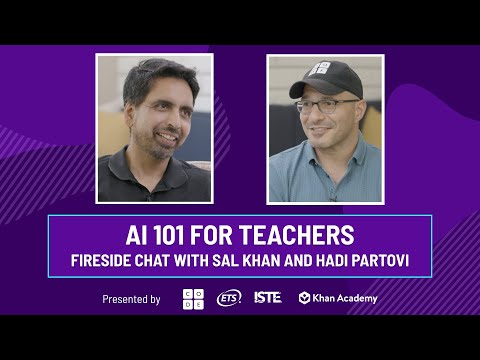
Part 2 Fireside Chat with Sal Khan and Hadi Partov

Only editable by group admins

  • Last updated December 13, 2023 at 10:02 AM by sweethometc
  • Evidence visible to public
This "fireside" discussion introduces many topics that educators are faced with as AI evolves each day.

Your Task…

  1. Watch the video below
  2. Complete the tasks in “Evidence of Learning” by submitting your responses.


Highlights…
  1. (05:58) What do educators think of AI?
  2. (06:58) Is using AI cheating?
  3. (12:59) School districts banning AI
  4. (14:29) How does AI impact the future role of educators?
  5. (16:43) How is AI impacting various industries?
  6. (20:54) What skills do students need to learn?

Evidence of Learning...

  • Explain how educators might combat “cheating” so AI in the classroom can be beneficial.
  • What tech tools have you already used that have AI built into them??  Describe your experience thus far.

All posted evidence

How to prevent cheating with AI and using it in the classroom

Educators can combat cheating by shifting their approach to how AI is used in learning. Instead of banning it, teachers can teach students how to use AI responsibly and with boundaries, like using it to brainstorm, get feedback, or improve writing skills. Assignments can also be designed in ways that make it harder to cheat, such as requiring personal reflections, process steps, or in-class presentations. By guiding students on ethical use and integrating AI into learning activities, teachers can help students develop critical thinking while still benefiting from AI tools.

In my kindergarten classroom, I use Canva to create colorful and engaging visuals for our station rotations. The simple drag-and-drop tools make it easy to design charts with icons and images that help young learners understand where to go and what to do, even if they can't read yet. I also use ChatGPT to assist with writing thoughtful and personalized report card comments, helping me save time while still reflecting each child’s progress accurately. Additionally, I use it to help craft our morning messages, making them fun, age-appropriate, and aligned with what we're learning each day. Together, Canva and ChatGPT make planning and communication more efficient and creative in my classroom.
jenniealessi About 1 year ago

Part 2: Fireside Chat

Teachers can combat cheating by presenting students with the proper AI tools such as Khan Academy that is created specifically for the purpose of education. Additionally digital literacy is imperative when using AI. it is important to educate students on the misinformation and bias AI tools may provide which would hinder their learning while using the tool. To combat cheating, teachers need to educate students how to use AI tools to enhance their learning rather than just doing the work for the students. It is important that students understand that AI should not be doing the work for you, but rather be doing it with you. Additionally teachers can use AI to see if a student is using AI to cheat. They can set up a second AI monitor to see what the students are doing.

I haven’t dabbled in many AI tools yet, but I have used ChatGPT. I have used it to help me write emails to parents with behavior concerns, create newsletters for my classroom and aid me in creating more authentic report card comments. This has been very helpful to ensure that my intended message is clear and concise. I would like to use more AI tools in the classroom in the future.
streebela About 1 year ago

AI and cheating

AI is becoming a big part of education, but that also means students might use it to cut corners. Instead of banning AI, teachers can guide students on using it responsibly. Here are some ways to make AI a helpful tool rather than a cheating shortcut:
  1. Change How We Test Knowledge – Instead of basic essays or multiple-choice tests, teachers can assign projects that require personal insights, creativity, or hands-on work. AI can’t replicate real experiences or deep critical thinking.
  2. Teach AI Literacy – Students should understand when AI is a helpful assistant and when it crosses the line into dishonesty. If they see AI as a tool for learning, not just a way to get answers, they’ll use it more responsibly.
  3. Use AI to Catch AI – AI detection tools can help teachers spot AI-generated work, but they should be used as just one part of an overall approach—not as a perfect solution.
  4. Encourage Honesty & Effort – Talking openly with students about why learning matters (beyond just grades) can help create a culture where they want to put in the effort instead of relying on AI shortcuts.
  5. Let AI Help, Not Replace – AI can be used in ethical ways, like brainstorming ideas, improving writing, or tutoring students on tough subjects. When used right, it can make learning more engaging and personalized.
By shifting the focus to learning over just getting the “right” answers, AI can be an incredible classroom tool rather than a problem.

I’ve used a few AI-powered tools that make life easier:
  • Grammarly – It helps catch typos and suggests better wording, making writing clearer and more professional.
  • Google Docs' Smart Compose – It predicts what I’m about to type, which speeds up writing processes.
So far, AI has been a great assistant. When used the right way, AI can be a real game-changer in education.
mbruce About 1 year ago

Don't avoid it- explore it!

I think there’s a lot of ways that AI can be beneficial in the classroom. I especially believe we can’t avoid it or ignore it. Educators can encourage students to use AI in productive and meaningful ways. For example, for a recent writing project I did with students, we talked as a group about the ways in which AI could be helpful for this particular project, and we also talked about what would be considered plagiarism for this particular project if AI was not used appropriately. 

We have used AI photo generators as team builidng activities in advisory. We also use Padlet a lot, which also has AI features. 
dmcwhite About 1 year ago

Part 2 Fireside Chat with Sal Khan and Hadi Partov

  • Explain how educators might combat “cheating” so AI in the classroom can be beneficial.
  • What tech tools have you already used that have AI built into them??  Describe your experience thus far.
Educators might combat "cheating" so AI can be more beneficial in the classrooms by rethinking the type of homework or classwork given. Educators need to realize that all the programs like Google, Google Docs, Microsoft, and others are using AI.  AI needs to be harnessed to enhance and perhaps personalize the students' learning experience. One idea is to use programs like Khanmingo, which allows educators to track or limit students' use of AI while performing a learning task. Specifically, Khanmingo has educational tools that monitor how AI is being used by a student. The teacher decides when students work on their own or can use AI depending on the purpose of learning tasks.

I have used several tech tools that have AI built into them. The basic tools are Google Docs, Google Sheets, and Microsoft. More recently, I earned a certificate for Canva Essentials. Canva has amazing AI tools. The editing tools Magic Eraser, Magic Grab, Grab Text, Background Remove, and Background Expand are AI-powered tools for editing photos.  Perhaps the most experimental AI on Canva is the image generator. This Elements tool allows you to ask AI to create a graphic by providing the generator with a 5 or more work description. It is crazy and fun!
sharon About 1 year ago

Explain how educators might combat “cheating” so AI in the classroom can be beneficial.

Educators can teach, reinforce the tenets of digital citizenship to combat cheating. Also, educators can teach students how to effectively use AI as a tool to enhance, give prompts or allow a different perspective. This approach to embracing AI as an educational tool will allow students to prepare themselves for their future.
nmcloughlin About 1 year ago

AI in teaching


Before watching this, I really did just think that AI was a cheating tool for students, especially since I teach English, and even a writing based college-level course. I have caught students turning in full assignments using AI like chatGPT, so that has been my experience with this. However, most of this video was showing this positive side of AI- it explained that it can be seen more as a tutor to help guide students, and we just have to reframe our homework assignments/assessments. I liked the comparison between an older sibling who can help students, and the point that not every student has a parent/sibling helping them, and not every family can afford a tutor. In this, AI can create a more equitable experience for students who lack these resources. 

Some tools I use are grammarly extensions on my computer that will fix/suggest edits to my writing. I also use AI when contacting companies to help problem solve- sometimes entering a "chat" with them is easier however, when the issue is more serious, a human is needed to understand and help solve it and in this, it can be frustrating at times.
I do need to start using AI more to lesson plan/create ideas to make my job easier because I have not used it for anything like that yet. 
heatherpaolucci Over 1 year ago

questions

  • Explain how educators might combat “cheating” so AI in the classroom can be beneficial.
- Educators can combat cheating by educating students of the harms of utilization whether is the possibility of getting information with biases. It is also important for educators to obtain a background on the students personal writing style. This can help with spotting excessive AI use and cheating. 
  • What tech tools have you already used that have AI built into them??  Describe your experience thus far.
I have utilized Siri and Alexa. I do like utilizing these since it provides quick and convenient tasks to be completed such as listening to music or finding quick solutions or facts. 
simsings28 Over 1 year ago

AI and cheating

  • Explain how educators might combat “cheating” so AI in the classroom can be beneficial.
Something I do with my students is presenting them with sample writing that is written by a human and wiring produced by AI. I ask them to evaluate which one is better, and more often than not, they pick the human generated text, citing reasons such as AI generated content "lacks warmth" or "seems fake". There are AI checkers like Turnitin.com or Chat gptzero, but I I think using AI as a teaching tool is far more effective in showing students how relying on this tool too heavily is risky.  
  • What tech tools have you already used that have AI built into them??  Describe your experience thus far.
My students are big fans of Grammerly, which is powered by AI. However, when the student relies to heavily on this tool to essentially rewrite entire sections of their essays. When the syntax of the sentence is so altered it becomes robotic, an AI-checker is going to flag their writing for authenticity. It's impossible to ban AI tools, so it's important for teachers to have one on one interactions with their students and discuss their writing process. There's a fear that AI could replace teachers. However, I think this only shows the value of irreplaceable, genuine teacher intervention.
lfeyes Over 1 year ago

Combating AI

Combating AI can be difficult because we cannot monitor each student all the time. Teaching students how and when to use AI could be a useful tool in aiding their learning. For ENL students it would be an opportunity for them to see models of language use that they could observe and learn from to use in their own writing. 

I have not yet done this but I am definitely interested in the the idea for ENL students. 
jessicawhitcomb Over 1 year ago

Part 2: Cheating, tools I've used

  • Explain how educators might combat “cheating” so AI in the classroom can be beneficial.
Something that stuck with me from the Video that was talked about by Sal Khan and Hadi Partovi was that we cannot control what kids do/how kids complete school work outside of school. Many children do not have people watching over them to make sure that they are doing their work correctly/not cheating, many of these children might turn to AI to complete their work. A way to combat this could be to build a "work" time into the school day where children can practice the work that they learned in school. This way, children will be able to ask while there is a teacher available to aid them if they have questions. I also believe it may be beneficial to explain the short comings of AI. Right now, AI is not a "perfect" tool. Explaining this to age appropriate children may help them understand when and how to use AI appropriately. 
  • What tech tools have you already used that have AI built into them??  Describe your experience thus far.
I have used Chat GPT very sparingly, more for silly reasons such as seeing what jokes it could tell or different gift ideas etc. I have noticed when doing quick google searches, often times the first result is an AI result. I do find myself reading this information, however I notice that I usually scroll for a different response. The AI may not be detailed enough or accurate enough for what I am looking for.
ckearney Over 1 year ago

Part 2

We can have guardrails for students in the classroom that use AI. There are specialized apps that monitor student work and actively notify teachers and parents when a student has created something using AI. Khanmigo and Turnitin are two products that have this capability. We can't get rid of AI, so we have to be smart about how we use and monitor the usage of AI.
The only tech tool that I have used with AI is ChatGPT. I have used it on a more personal level in finding potential restaurants and unique areas when traveling. On a professional level, I have used ChatGPT in making worksheets, enhancing labs or activities, or assisting with the writing of letters of recommendation.
mricupito Over 1 year ago