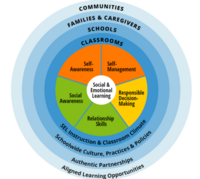
The CASEL Framework

Responsible Decision Making

Only editable by group admins

  • Last updated September 26, 2022 at 7:50 AM
  • Evidence visible to public
Describe a key learning about Responsible Decision-Making. Share one specific way you are encouraging responsible decision-making in your classroom.

All posted evidence

Responsible Decision Making

Repsonsible decision making entails being open minded, identifying and solving problems, analyzing situations and consequences, responsisbilty and reflection.  I try to address these concerns as they arise, on the spot (whether it is a postive situation or negative) rather than wait it out or ignore it.  I try to dialogue with the students the choices they had in a situation and how their choice went.  I also try not to over talk it, and move on so it doesn't escalate.  If needed, and appropriate the discussion might be done in private (after a class) if the same concerns arise.  When I see students making good choices, especially after not so good choices, I make sure to acknowledge it, and praise them for the good choice.  When they are young, they need to know they are seen when making these good choices and hopefully will become second nature as they mature.
joan-loughran 3 months ago

Responsible Decision Making

Responsible decision making means the ability to make positive, constructive decisions about how to behave, based on consideration of ethical standards (right and wrong) as well as relevant social norms and safety concerns.  An example of this would be learning how to make a reasoned judgment after analyzing information, data, and facts.  One way I encourage responsible decision making is by playing the game "Would you rather?".  It's a fun game to play at the beginning of the school year to get to know each other and create a safe and welcoming environment.  During the game, students think through decision-making.  Would you rather get $100 a week or $5,000 a month?  Why?  I need to make a better effort to play this game periodically throughout the school year instead of only as a welcome-back-to-school game.  
jsherman 7 months ago

Responsible Decision Making

Responsible decision making involves the ability to make good choices and decisions. It entails keeping an open mind and solving problems on our own. 

I teach this skill through a lot of hands on activities and storybooks.  It is important to give my students opportunities to make their own choices and decisions and learn through the natural consequence of their decisions. This includes positive as well as negative consequences. During these activities, I tie in questions that target inferences and predictions which fosters problem solving and reasoning. The students enjoy the freedom they are given to make their own choices then see consequences of their choices. Allowing responsible decision making provides multiple opportunities for my students to engage in conversation. We discuss their choices, assess if they were good decisions, if they should have done something differently and then talk about rationales for their choices.  

anna77 7 months ago

Responsible Decision Making

Responsible decision-making means thinking carefully about the choices we make, understanding what might happen because of those choices, and doing what’s right for ourselves and others. It involves looking at different options, solving problems, and considering how our actions affect others. In my classroom, I encourage responsible decision-making by giving students hands-on design projects. These challenges require them to evaluate multiple solutions, predict the potential impact of their decisions, and consider how their choices will affect others. By engaging in these activities, students are prompted to think critically about the consequences of their decisions, weigh various factors, and make choices that are good for them and everyone else involved.
greg-soposki 8 months ago

Responsible Decision Making

One key learning that I found with responsible decision-making was analyzing situations and consequences. I think particularly at this time of the year, students exhibit more challenging and disruptive behaviors. They tend to "check out" and lose motivation if a task seems too challenging. One way that I encourage responsible decision-making in this way is to provide options as often as possible and support those options with strong reasoning.

For example, one of my students is doing a research paper and he feels that he should've chosen another topic because he's having trouble finding support. In response, we considered starting the research project from scratch, but he only needed two more pieces of evidence for what he's currently working on. With positive encouragement in helping to identify two more pieces of evidence, he decided to keep the research project he was on. I may also need to justify my classroom decisions; "I decided to move your seat because you seem distracted" or "let's organize our ideas so that we feel more confident moving forward".
fdambro 9 months ago

Responsible Decision Making


Responsible decision making is made from the collection of information we obtain from the other 4 competencies of the CASEL competency wheel. This involves the ability to carefully listen and be open-minded to make the best decision possible. This involves understanding the benefits and possible consequences of each decision we make. A very important value we teach students is to do what is ethically right as we need to maintain their integrity even when it may not be the easiest decision to make.

As educators, we are in position to promote responsible decision making through leading by example. Children are very impressionable, they can observe how I respectfully respond to them even in a time of stress or crisis. In addition, we use a theme for many of our units such as respect, trust, integrity, etc. Working with the selected theme, we can ask each student to identify one positive character skill they have demonstrated within the last week. I feel that this will help students be aware, open-minded, and promote responsible decision making.  Additionally, we can discuss the history of famous athletes that have demonstrated high levels of character, perseverance and discipline which has helped them reach an elevated level of success.

kevin-bovi 10 months ago

Responsible Decision-Making

Responsible decision-making is one of the five competencies of the CASEL framework.  It involves the ability to problem solve by analyzing situations, being open-minded, showing ethical responsibility, and being able to reflect on one's role in promoting one's own well-being and the well-being of others.

We do a lot of character analysis in my classroom.  This lends itself very well to scenario-based learning where we write about real-life problems and potential consequences of different choices that can be made.  We have discussions about past choices:  What was the outcome?  Could they have handled things differently?  I encourage my students to reflect on decisions that they have made, both positive and negative, and we try to determine what factors influenced those choices.  
katie-jadhon 11 months ago

Responsible Decision Making

Some important insights I gained from the CASEL framework on responsible decision-making include the significance of maintaining an open mind, identifying potential solutions to problems, understanding the consequences of our actions, and critically analyzing information before making decisions. These elements are crucial not only in academic settings but also in life beyond the classroom. As I continued my research beyond the CASEL framework, I identified four core factors contributing to students' ability to make responsible and sound decisions. These four characteristics are open-mindedness, integrity, the ability to make judgments based on valid information (such as data and facts), and the skill to find effective solutions to problems. These components form the foundation for cultivating responsible decision-makers who are equipped to face challenges both in and out of the classroom.
I am deeply committed to helping my students strengthen these qualities. To promote open-mindedness, I encourage students to consider multiple perspectives before making decisions and appreciate our class's diversity of opinions. For integrity, I emphasize the importance of honesty and doing the right thing even when it may be difficult. I also ensure that students understand the value of making judgments based on evidence—whether that be factual information, research, or personal experience—rather than assumptions or hearsay. By fostering critical thinking, I hope to help them recognize the importance of gathering and evaluating reliable information before reaching conclusions.
To support problem-solving skills, I provide opportunities for students to engage in collaborative discussions where they can brainstorm solutions together. I actively involve them in classroom decisions by taking written suggestions and allowing them to contribute to the creation of classroom rules and procedures. This gives students a sense of ownership and responsibility in their environment. Whenever possible, I also offer choices in assignments, which helps them feel empowered and more invested in their work.
Additionally, we regularly engage in conversations about the consequences of our actions—both positive and negative. These discussions help students reflect on their choices and consider the impact their decisions may have on themselves and others. I believe that by consistently reinforcing these key principles, students will not only improve their decision-making skills but also develop the confidence to make thoughtful, informed choices in various aspects of their lives.

nickolasbuckley 11 months ago

Responsible Decision Making

Responsible Decision-Making is the importance of helping students think critically about their choices and consider the impact of their actions on themselves and others.

I would use the “What Would You Do?” scenarios to encourage decision-making in the classroom.  I have used these before as bell-work when we were online during COVID.  I happened upon them in TPT and some were really fun questions and already pre-made.   The questions make for great discussions and they aren’t math related.
agilland About 1 year ago

Responsible Decision Making

A key take away for me is that without all of the other discussed skills you can't make responsible decisions. You have to know yourself, understand how a decision may make others feel and use all of that SEL to make a good decision. This makes me think of students who make poor decisions and don't have the skills to make better ones. Something our school could do to help all students is utilize our school counselors and social works to do lessons with students about these skills providing long term benefits. 
nicole-gerardo Over 1 year ago

Responsible Decision Making

A key learning about responsible decision-making is the ability to consider ethical, social, and academic factors when making choices and taking action.  It involves identifying and evaluating options, weighing the potential consequences, and making informed decisions that align with one's values and goals.

In my math classroom, I promote responsible decision-making through problem-solving activities that require students to analyze real-world scenarios and make decisions based on mathematical principles and ethical considerations.  One specific way I do this is by incorporating case studies or mathematical dilemmas into our curriculum.  For example, I might present students with a scenario involving budgeting decisions, where they must allocate limited resources to different expenses while considering factors such as needs versus wants, cost-benefit analysis, and long-term financial planning.  I facilitate discussions where students explore the mathematical aspects of the scenario, as well as the ethical implications of their decisions. Students are encouraged to consider various perspectives, brainstorm potential solutions, and justify their choices using mathematical reasoning and critical thinking skills.  Through this process, students learn to apply mathematical concepts to real-world situations, evaluate the consequences of their decisions, and make responsible choices that reflect their understanding of mathematical principles and ethical values.  By engaging in problem-solving activities that integrate responsible decision-making, students develop essential life skills that will serve them well beyond the math classroom, empowering them to navigate complex situations and make thoughtful choices in their personal and academic lives.
derekrichards Over 1 year ago

Responsible Decision Making

Responsible decision-making is making good choices through curiosity, analysis, and reflection.  We should be curious to learn more about situations and analyze any consequences before making decisions.  We should also be able to solve problems on our own or together.  I think I encourage students to make good choices.  When we review for a test it is their responsibility to complete the review assignment.  They must also check their answers online and ask any questions.  We talk about the importance of completing both homework and review because it will benefit their test scores.  If they do not practice math, their academic grades will be lower, as a consequence. 
melissa7 Over 1 year ago