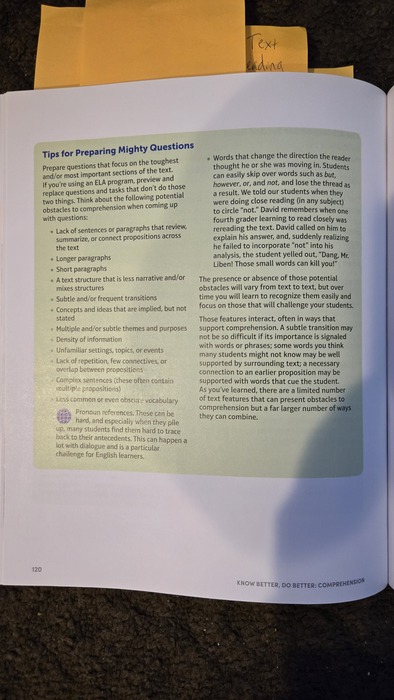


It is often recommended to ask students questions about what they've read in order to find out if they comprehended it. But how do you know what questions to ask? Are some questions better than others?
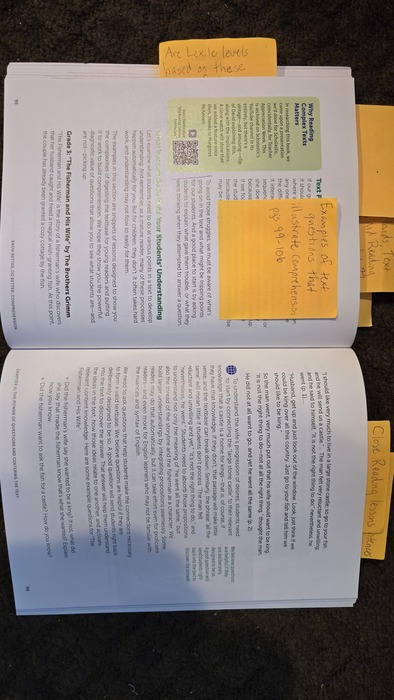
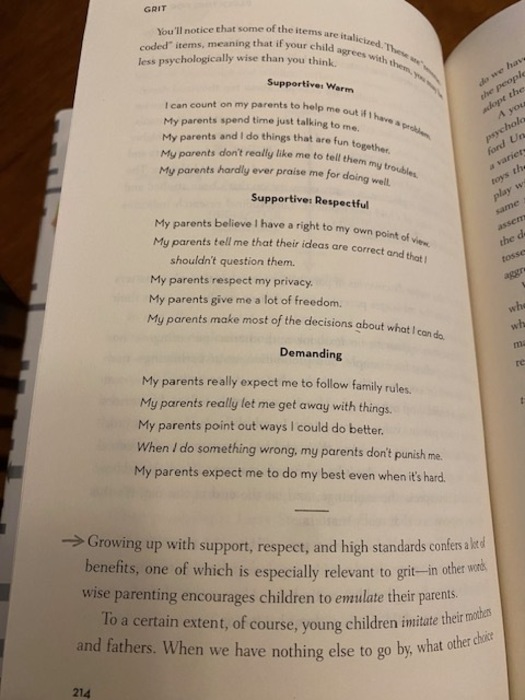
On pages 98-106, the authors provide short text passages at various grade levels, along with examples of questions that focus on the crucial parts students need to understand. By asking questions about these parts, teachers can quickly assess a student's reading comprehension and where/why they misunderstand. When students answer incorrectly, teachers should ask them to share their thinking to gain insight into which text feature tripped them up. The authors prefer doing this Q&A in large group discussions to give all students access to their classmates' thinking, which is an interesting concept... I feel like sometimes it's hard to keep all students engaged if whole groups sessions get lengthy.
The authors also suggest developing these kinds of questions to use during read-alouds to assess listening comprehension.
It's so helpful to have these examples to learn from!
On pages 98-106, the authors provide short text passages at various grade levels, along with examples of questions that focus on the crucial parts students need to understand. By asking questions about these parts, teachers can quickly assess a student's reading comprehension and where/why they misunderstand. When students answer incorrectly, teachers should ask them to share their thinking to gain insight into which text feature tripped them up. The authors prefer doing this Q&A in large group discussions to give all students access to their classmates' thinking, which is an interesting concept... I feel like sometimes it's hard to keep all students engaged if whole groups sessions get lengthy.
The authors also suggest developing these kinds of questions to use during read-alouds to assess listening comprehension.
It's so helpful to have these examples to learn from!