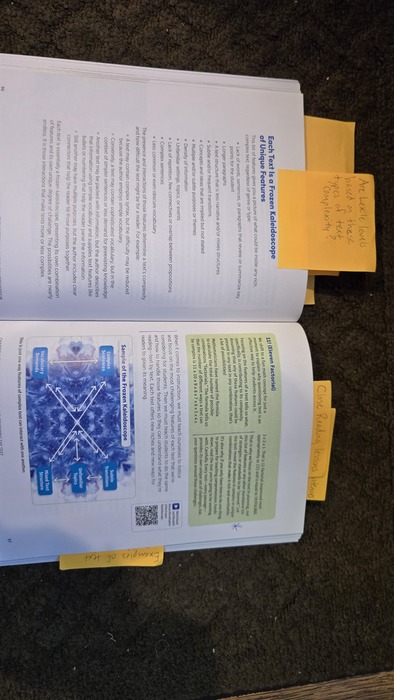


Something new that I'm thinking about is the authors' idea that teachers should focus on the specific text being used, rather than a list of text features or reading strategies or standards to be "covered." Instead, teachers should choose what reading skills or strategies to teach based on the features in that unique text. The text determines the lesson, rather than the lesson determining the text. In many reading programs, the texts are disconnected from each other because they are chosen for which reading skill can be taught with them. Experts in reading comprehension now recommend using texts on connected topics, and choosing the reading skills to teach based on the features of those texts.
The authors write "When it comes to instruction, we must teach ourselves to notice and focus on the most challenging features of each text that we're considering for students. Then we must teach students to do the same and how to handle those features so they can understand what they're reading-- text by text. Each text offers new riches and new ways for readers to glean its meaning." (pg 97)
A question I have: are Lexile levels based on the types of complexity the authors list here, eg. longer paragraphs, mixed text structures, subtle or frequent transitions, complex sentences, less common vocabulary? I need to read more about Lexile levels from another source to find this answer...
The authors write "When it comes to instruction, we must teach ourselves to notice and focus on the most challenging features of each text that we're considering for students. Then we must teach students to do the same and how to handle those features so they can understand what they're reading-- text by text. Each text offers new riches and new ways for readers to glean its meaning." (pg 97)
A question I have: are Lexile levels based on the types of complexity the authors list here, eg. longer paragraphs, mixed text structures, subtle or frequent transitions, complex sentences, less common vocabulary? I need to read more about Lexile levels from another source to find this answer...